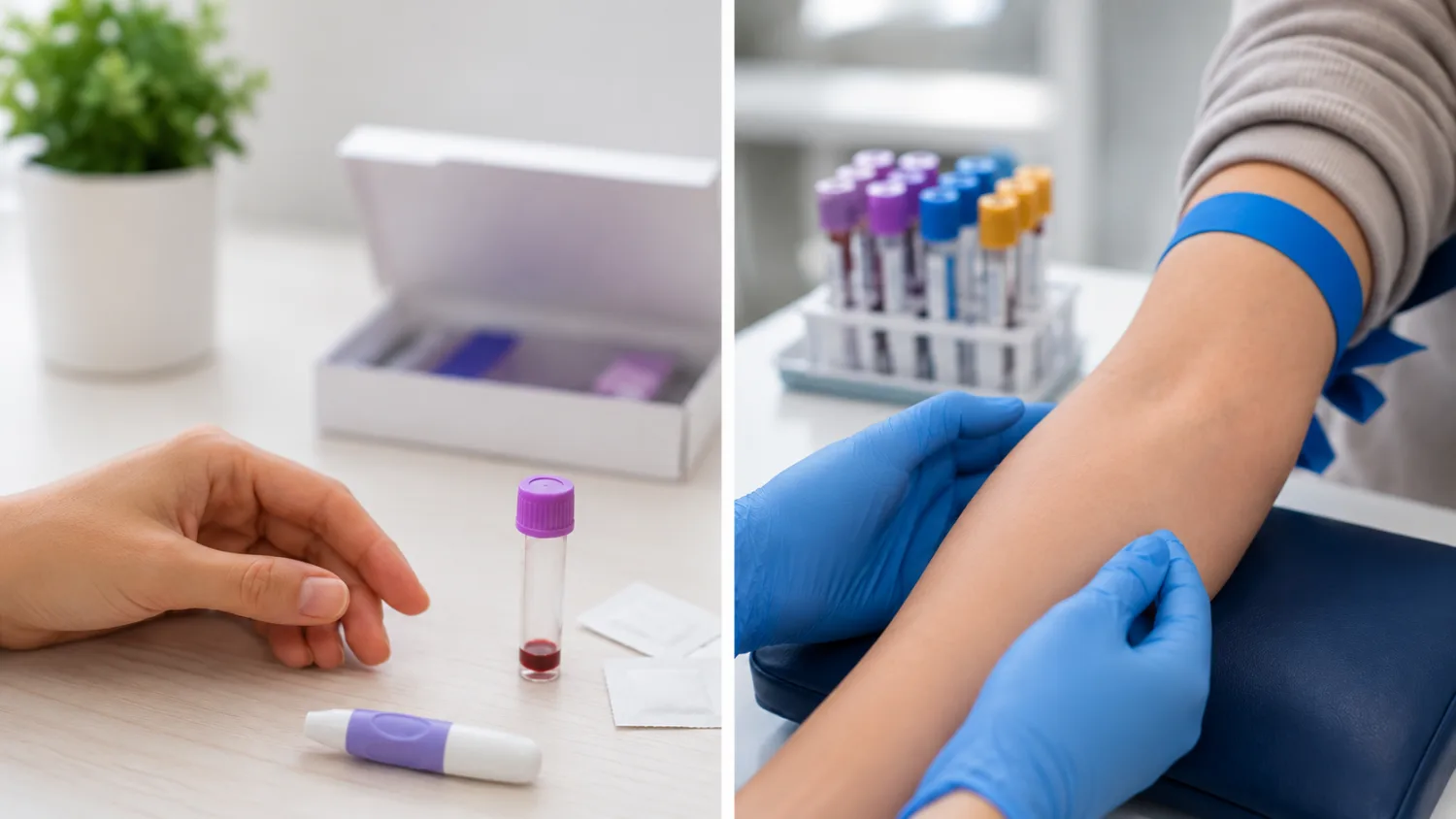
Finger-prick and venous blood tests are both used to check blood markers, but they are not exactly the same. A finger-prick test uses a small sample of capillary blood from the fingertip. A venous blood test uses blood taken from a vein, usually from the inside of the arm.
Both methods can be useful. Finger-prick blood tests are convenient, especially for at-home testing and simple private health checks. Venous blood tests are usually better for larger panels, important diagnostic decisions, repeat confirmation, hospital testing and situations where sample quality is critical.
The difference matters because many private home blood test kits use finger-prick sampling. They can be accurate for some markers if collected properly and processed by a suitable laboratory. But finger-prick samples are more vulnerable to collection problems, small sample volume, clotting, delays and interpretation issues.
This guide explains how finger-prick and venous blood tests compare, which tests are often suitable for each method, when finger-prick results need caution, and when it is safer to choose or confirm with a venous blood test.
Important: This article is for general information only. If you have urgent symptoms such as chest pain, severe shortness of breath, black stools, vomiting blood, collapse, confusion, severe weakness, severe abdominal pain, signs of stroke or suspected sepsis, do not rely on a home finger-prick test. Seek urgent medical advice.
Finger-prick vs venous blood tests at a glance
The main difference is where the blood comes from and how much blood is collected. Finger-prick tests use capillary blood from tiny blood vessels near the skin surface. Venous tests use blood from a vein, usually collected by a healthcare professional.
| Feature | Finger-prick blood test | Venous blood test |
|---|---|---|
| Sample source | Capillary blood from the fingertip | Blood from a vein in the arm |
| Who collects it? | Often self-collected at home | Usually a phlebotomist, nurse, doctor or healthcare assistant |
| Sample size | Small | Larger |
| Convenience | High | Requires appointment or home phlebotomy |
| Risk of collection error | Higher | Lower when collected by trained staff |
| Best for | Selected markers, screening and convenient monitoring | Diagnosis, larger panels, confirmation and clinically important decisions |
| Common problem | Insufficient, clotted or delayed sample | Needle discomfort, appointment access, bruising |
A finger-prick test is not automatically unreliable. A venous test is not automatically perfect. But venous samples generally give laboratories more blood to work with and reduce many of the collection problems that affect self-collected samples.
For a broader guide to home testing, see At-Home Blood Test Kits: Are They Accurate?.
What is a finger-prick blood test?
A finger-prick blood test uses a small lancet to prick the side of the fingertip. Drops of blood are then collected into a small tube, onto a testing strip, or into a device depending on the test.
Finger-prick testing is common in several settings. People with diabetes may use finger-prick testing to check blood glucose. Some private companies use finger-prick samples for home blood test kits. Some pharmacies and clinics use finger-prick testing for quick checks such as cholesterol or HbA1c.
For private home testing, the usual process is:
- You order a test kit online.
- The kit arrives with lancets, collection tubes, wipes, plasters and return packaging.
- You collect blood from your fingertip at home.
- You post the sample to a laboratory.
- You receive results online, sometimes with clinician comments.
Finger-prick testing is convenient because it avoids a clinic visit. But the sample depends heavily on your collection technique. If there is too little blood, the blood clots, the tube is not mixed correctly, the sample is delayed in the post, or the wrong timing is used, the result may fail or be misleading.
What is a venous blood test?
A venous blood test is taken from a vein, usually in the arm. A trained person places a needle into a vein and collects blood into one or more tubes. Each tube may contain different additives depending on the tests requested.
This is the standard method used for most NHS blood tests, hospital blood tests, private GP tests and specialist clinic testing. Venous samples are especially useful when a larger amount of blood is needed, when multiple markers are being tested, or when the result may affect diagnosis or treatment.
Venous testing is commonly used for:
- full blood count
- kidney and liver function
- thyroid tests
- hormone testing
- infection and inflammation markers
- specialist tests
- repeat confirmation of abnormal results
- hospital and urgent care investigations
Venous blood tests are less convenient than home finger-prick tests, but they usually provide a more robust sample. If a result is very important, unexpected or difficult to interpret, venous testing is often the safer option.
Are finger-prick blood tests accurate?
Finger-prick blood tests can be accurate for some markers, but accuracy depends on the test, sample quality, collection technique, laboratory process and interpretation.
A finger-prick result is more likely to be reliable when:
- the marker is suitable for capillary blood testing
- the kit instructions are followed carefully
- enough blood is collected
- the sample does not clot
- the tube is filled and mixed correctly
- the sample is posted quickly
- the laboratory is suitable for the test
- the result is interpreted with symptoms and medical history
A finger-prick result is more likely to be unreliable or unhelpful when:
- the sample is too small
- the finger is squeezed too hard
- the sample clots
- the sample is delayed in the post
- the test needs more blood than the kit can provide
- the result is borderline or unexpected
- the test was taken at the wrong time of day or cycle stage
- the result is used without clinical interpretation
The biggest issue with finger-prick testing is often not the laboratory analysis itself. It is the quality and suitability of the sample before it reaches the laboratory.
Why venous blood tests are often preferred for diagnosis
Venous blood tests are often preferred when a result matters clinically because they provide a larger, cleaner and more controlled sample. The blood is collected by someone trained in phlebotomy, labelled properly, placed into the correct tubes and sent through established laboratory pathways.
Venous testing is usually better when:
- you are investigating symptoms rather than doing a simple screen
- the result may lead to treatment
- the result may lead to referral
- the test is part of NHS or specialist care
- a large panel is needed
- previous finger-prick samples failed
- a private home result was abnormal
- the result is borderline but important
- the marker is sensitive to sample handling
- the result does not match how you feel
Venous testing also allows more than one tube to be taken. This matters because different blood tests need different tube types. A full blood count, clotting test, glucose test, liver profile, hormone test and inflammation marker may not all use the same sample tube.
If you are having tests through an NHS GP, hospital or specialist, venous blood testing is usually the standard route. For more on NHS and private routes, see NHS vs Private Blood Tests.
Which tests are often suitable for finger-prick samples?
Some tests are commonly offered by finger-prick home kit providers and may be reasonable for non-urgent screening or monitoring. Suitability still depends on the provider, laboratory, sample quality and your reason for testing.
HbA1c
HbA1c checks average blood sugar over the previous two to three months. It is commonly offered through home testing providers and can be useful for diabetes or prediabetes risk screening. Abnormal results should be discussed with a clinician, especially if you have symptoms such as thirst, frequent urination, weight loss or recurrent infections.
See HbA1c and Blood Sugar Results Explained.
Cholesterol
Cholesterol testing can be done by finger-prick in some settings. It may be useful for screening or monitoring, but cholesterol should be interpreted with overall cardiovascular risk, including blood pressure, smoking, diabetes, kidney disease and family history.
See Cholesterol Blood Test Results Explained and Cardiovascular Risk: The Complete Guide.
Vitamin D
Vitamin D is commonly tested using home finger-prick kits. This may be useful if deficiency is suspected, if you are monitoring supplementation, or if you have risk factors. But repeated testing is not always necessary for everyone.
See Vitamin D Blood Test Results Explained.
Ferritin
Ferritin reflects iron stores. Finger-prick ferritin testing may be useful for some people with fatigue, heavy periods, hair shedding, restless legs or previous low iron stores. However, low ferritin needs clinical context, especially in men, postmenopausal women or anyone with gut symptoms.
See Low Ferritin but Normal Haemoglobin and Iron, Ferritin and Anaemia Blood Test Results Explained.
B12 and folate
B12 and folate may be offered in home testing panels. They can be useful when symptoms or risk factors fit, but interpretation is not always simple. Results may need to be interpreted with full blood count, diet, medication, gut conditions and symptoms such as pins and needles, mouth ulcers or fatigue.
See B12 and Folate Blood Test Results Explained.
Which tests need extra caution with finger-prick samples?
Some markers are more sensitive to timing, sample quality or clinical context. They may still be available as finger-prick kits, but results should be interpreted cautiously.
Full blood count
A full blood count can be technically more demanding because blood cell measurements depend on sample quality and correct tube handling. If a finger-prick full blood count is abnormal, unexpected or does not match symptoms, venous confirmation may be needed.
See Full Blood Count Results Explained.
Potassium and electrolytes
Potassium can be affected by sample handling and haemolysis, which means red blood cells break down in the sample. A falsely high potassium result can cause unnecessary alarm, while a genuinely high potassium can be medically important. If potassium is abnormal on a finger-prick sample, venous confirmation is often important.
See U&E Blood Test Results Explained.
Thyroid tests
Thyroid tests can be useful privately, but interpretation depends on symptoms, medication, pregnancy status, previous results and supplements such as biotin. Borderline or unexpected results may need venous repeat testing.
See Thyroid Blood Test Results Explained.
Hormone tests
Hormone tests are often more difficult to interpret than people expect. Female hormone results may need a specific cycle day. Progesterone depends on ovulation timing. Testosterone is often best interpreted from a morning sample and may need repeat testing if low.
See Female Hormone Blood Test Results Explained, Fertility Blood Tests Explained, Menopause Blood Tests Explained and Testosterone Blood Test Results Explained.
Allergy panels
Allergy blood tests should be targeted to a clear reaction history. Broad private panels can produce false positives and unnecessary food avoidance. The issue is not only the sample type; it is whether the test was clinically appropriate.
See Allergy Blood Test Results Explained.
Tumour markers
Tumour markers such as PSA or CA125 need careful interpretation. They are not simple “cancer yes/no” tests. A normal result can falsely reassure, and a raised result can be caused by non-cancer conditions. They should be used with medical guidance.
See PSA Blood Test Results Explained and CA125 Blood Test Results Explained.
Common finger-prick sample problems
Finger-prick blood tests are simple in theory, but home collection can be harder than it looks. Many failed or unreliable results come from collection problems.
Insufficient sample
The laboratory may not be able to run all tests if the tube is not filled to the required line. This is especially common with larger panels that need more blood.
Clotted sample
Some samples clot if collection takes too long or the tube is not mixed as instructed. A clotted sample may be rejected, or certain results may not be possible.
Haemolysis
Haemolysis means red blood cells have broken down in the sample. This can affect markers such as potassium, liver enzymes and some other chemistry results. Haemolysis may happen because of squeezing, rough handling, delay or sample transport issues.
Dilution from tissue fluid
If you squeeze your finger too hard, tissue fluid can mix with the blood. This may dilute the sample and affect some results.
Delayed postage
Some markers are affected by time and temperature. Posting a sample just before a weekend or bank holiday can increase the risk of delay.
Wrong timing
Some tests are affected by time of day, menstrual cycle day, fasting status, recent exercise, alcohol, illness or supplements. A technically successful sample can still produce a misleading result if it was taken at the wrong time.
How to improve a finger-prick blood sample
Always follow the instructions in your own test kit. Different providers may use different tubes and handling rules.
General tips include:
- read the instructions before starting
- check whether fasting or morning timing is needed
- avoid taking the sample just before weekends or bank holidays unless the provider says it is safe
- drink water beforehand unless you have been told not to
- warm your hands in warm water for a few minutes
- stand up or let your hand hang down to improve blood flow
- use the side of the fingertip rather than the centre
- wipe away the first drop if instructed
- avoid scraping your finger on the tube
- avoid aggressive squeezing
- fill the tube to the required line
- mix the tube gently if instructed
- label the sample correctly
- post the sample as soon as possible
If you have poor circulation, cold hands, needle anxiety, tremor, previous failed kits, or you need a large panel, venous testing may be easier and more reliable.
When to confirm a finger-prick result with a venous test
A finger-prick result may be useful as a first check, but some results should be confirmed with a venous blood test.
Consider venous confirmation if:
- the result is significantly abnormal
- the result is unexpected
- the result does not match your symptoms
- the result may lead to medication
- the result may lead to referral
- the sample was difficult to collect
- the provider reported haemolysis or sample quality issues
- potassium, calcium, kidney function or liver results are abnormal
- a full blood count result is abnormal
- a hormone result is borderline or important
- you are unwell or have red-flag symptoms
For example, a mildly low vitamin D result from a finger-prick sample may be straightforward to act on. But a high potassium, very abnormal calcium, unexpected low haemoglobin, raised liver enzymes, abnormal kidney function or low testosterone result may need venous confirmation and clinical review.
If a private result is abnormal, see What to Do After Abnormal Private Blood Test Results.
Choosing between finger-prick and venous testing
The best choice depends on why you are testing.
Choose finger-prick testing when convenience matters and the question is simple
Finger-prick testing may be reasonable if you want a non-urgent check, the marker is suitable for capillary blood, and you understand what to do with the result.
Examples include checking vitamin D after supplementation, monitoring ferritin if you have a known history of low iron stores, checking HbA1c or reviewing cholesterol as part of prevention.
Choose venous testing when the result really matters
Venous testing is usually better if you are investigating symptoms, confirming an abnormal result, testing many markers, checking medication safety, or making treatment decisions.
It is also usually better if the test is requested by a GP, hospital doctor, private GP or specialist as part of diagnosis or monitoring.
Choose clinical assessment, not self-testing, if symptoms are concerning
Blood tests are only one part of healthcare. If symptoms are serious, persistent or unexplained, you may need examination, blood pressure, urine tests, stool tests, ECG, imaging, referral or urgent care.
Do not use a finger-prick test as the first step for symptoms such as:
- chest pain
- severe shortness of breath
- black stools or vomiting blood
- blood in stool with weight loss or bowel changes
- fainting or collapse
- confusion or severe weakness
- severe abdominal pain
- persistent fever or night sweats
- unexplained rapid weight loss
- a new lump
- stroke-like symptoms
In these situations, contact your GP, NHS 111, urgent care or emergency services depending on severity.
Frequently asked questions
Is a finger-prick blood test as accurate as a venous blood test?
It can be accurate for some markers when collected properly and processed by a suitable laboratory. However, venous blood tests are generally more reliable for larger panels, important results and tests where sample quality matters.
What is the difference between finger-prick and venous blood?
Finger-prick tests use capillary blood from the fingertip. Venous blood tests use blood from a vein in the arm. Venous samples usually provide more blood and are collected under more controlled conditions.
Are home finger-prick blood tests reliable?
They can be reliable for selected tests, but they are more vulnerable to collection problems such as too little blood, clotting, haemolysis, delays and wrong timing.
Why did my finger-prick sample fail?
Common reasons include not enough blood, clotting, incorrect tube mixing, delayed postage, leakage, labelling problems or sample damage during transport.
Can squeezing my finger affect blood test results?
Yes. Squeezing too hard can mix tissue fluid with blood and may affect some results. Warming your hands and following the kit instructions can help blood flow more easily.
Which tests are suitable for finger-prick samples?
Some vitamin D, ferritin, HbA1c, cholesterol, B12 and selected monitoring tests may be suitable. It depends on the provider, laboratory and clinical question.
Which tests are better as venous blood tests?
Venous testing is often better for full blood count, potassium and electrolytes, large panels, hormones, specialist tests, abnormal result confirmation and tests used for diagnosis or treatment decisions.
Can finger-prick tests check full blood count?
Some providers offer it, but full blood count depends heavily on sample quality. Abnormal or unexpected results may need venous confirmation.
Can finger-prick tests check potassium?
Some panels include potassium, but potassium is sensitive to sample handling and haemolysis. Abnormal potassium results from finger-prick samples often need venous confirmation.
Are finger-prick cholesterol tests accurate?
They can be useful for screening or monitoring, but results should be interpreted with overall cardiovascular risk. Venous testing may be better for confirmation or treatment decisions.
Are finger-prick hormone tests reliable?
They can be useful in selected situations, but hormone tests often depend on timing, cycle day, medication and symptoms. Poorly timed results can be misleading.
Should I confirm an abnormal finger-prick result?
Often yes, especially if the result is significantly abnormal, unexpected, clinically important, linked with symptoms, or may lead to treatment or referral.
Is venous blood testing painful?
Most people feel a brief scratch or sting. Some may have mild bruising afterwards. Tell the person taking blood if you feel faint with needles.
Is finger-prick testing painful?
It usually feels like a sharp pinprick. Some people find it easy; others find it difficult to collect enough blood.
Can I use a finger-prick test instead of seeing a GP?
Not if you have concerning symptoms. Finger-prick tests can provide information, but they do not replace medical assessment, examination or appropriate referral.
Can I take private finger-prick results to my NHS GP?
Yes, but your GP may decide to repeat the test through NHS pathways before acting on it, especially if the result is unexpected or clinically important.
Is a home venous blood test better than a finger-prick test?
Often, yes. Home venous phlebotomy gives a larger sample taken by a trained person, while still offering convenience. It usually costs more.
Should children use finger-prick home blood tests?
Children’s testing should be guided by a clinician. Do not use private home tests for babies, children or teenagers with symptoms that need medical assessment unless a qualified clinician advises it.
What should I do if my finger-prick result is normal but I still feel unwell?
Speak to a GP or clinician. Normal blood tests do not rule out every condition, and some problems need examination, imaging, urine tests, stool tests, ECG or specialist review.
What is the safest way to use finger-prick blood tests?
Use them for clear, non-urgent questions; choose a reliable provider; follow collection instructions carefully; avoid over-testing; and confirm important or abnormal results with a clinician.