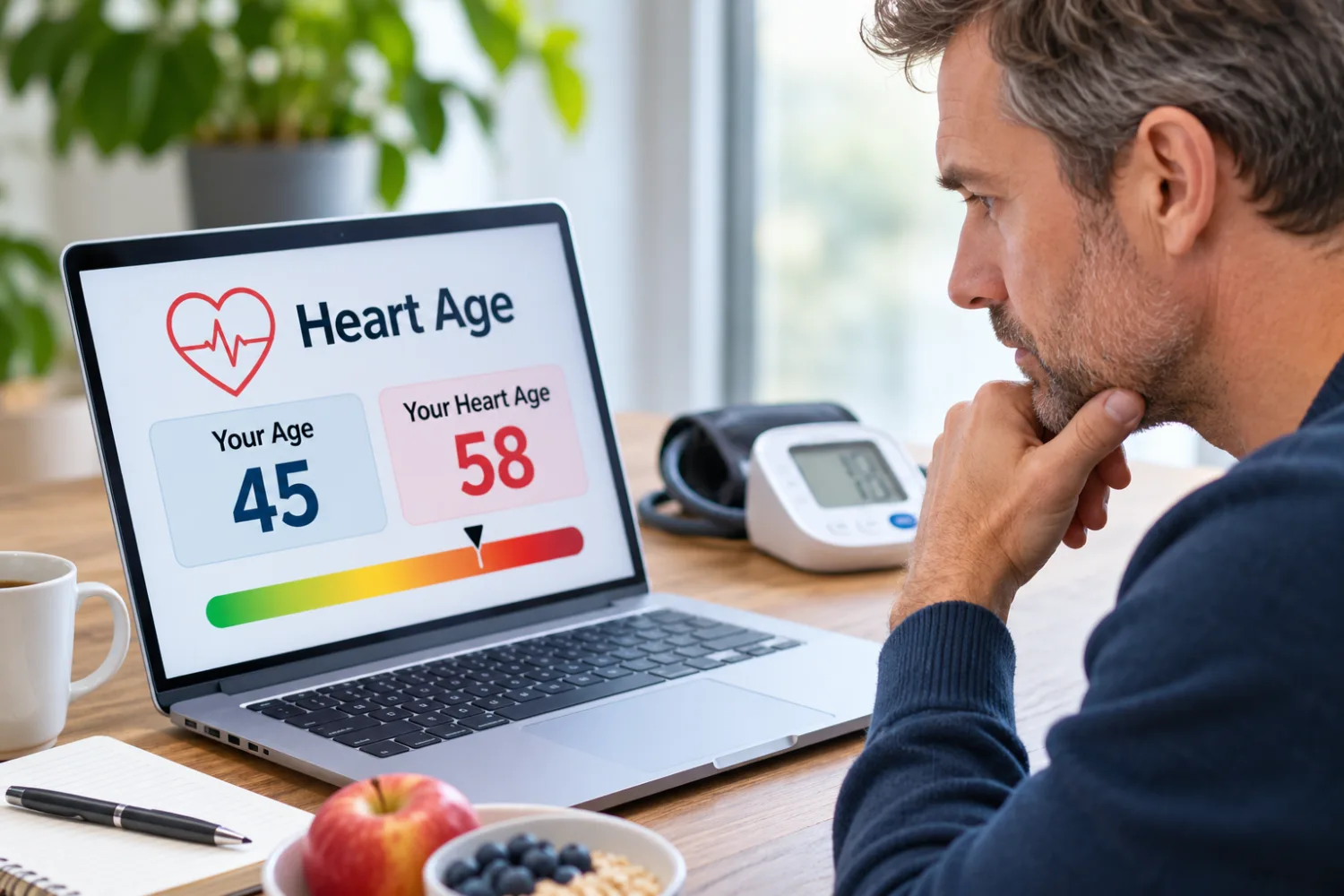
Being told that your “heart age” is 10 or 15 years older than your actual age can sound alarming.
But heart age is not a scan of your arteries, and it does not mean that your heart has literally aged faster than the rest of your body.
It is a way of turning cardiovascular risk into a number that feels easier to understand.
Instead of saying that your combination of blood pressure, cholesterol, smoking status and other factors gives you a particular future risk of heart disease or stroke, a heart-age calculator compares your risk profile with that of a person of a different age who has healthier risk factors.
That can be useful for motivation. A 45-year-old may pay more attention to “your heart age is 58” than to a percentage risk that feels abstract.
But the number also has limits. It cannot diagnose blocked arteries, tell you whether you have an abnormal heart rhythm or account perfectly for every inherited and emerging cardiovascular risk factor.
This guide explains what heart age means, how UK risk calculators work, what they can tell you and when additional assessment may be more useful than repeatedly checking an online score.
What Does “Heart Age” Actually Mean?
Heart age is a communication tool based on cardiovascular risk.
The current NHS Heart Age Calculator compares your actual age with an estimated cardiovascular “age” based on information about your health and lifestyle. It is intended for people aged 30 to 95 who live in the UK and do not already have established cardiovascular disease. You can use the NHS Heart Age Calculator here.
The NHS calculator uses the JBS3 cardiovascular risk model rather than simply adding up a few lifestyle questions.
It takes into account factors such as smoking, body size and medical history. Blood pressure and cholesterol can also be entered, and the NHS warns that the result may be less accurate if those measurements are not available.
So if your heart age is higher than your real age, the calculator is essentially saying that your current cardiovascular risk profile resembles that of an older person with healthier risk factors.
It does not mean that your heart muscle itself has been measured as physically older.
Heart Age Is Not the Same as Your 10-Year QRISK Score
Heart age and QRISK are related ideas, but they are not the same thing.
In UK clinical practice, NICE recommends QRISK3 for estimating the chance of having a cardiovascular event within the next 10 years in most adults aged 25 to 84 who do not already have cardiovascular disease.
That result is usually expressed as a percentage.
For example, a QRISK3 score of 12% means that, among people with a similar risk profile, roughly 12 in 100 would be expected to have a heart attack, stroke or related cardiovascular event within the next decade.
NICE currently recommends offering atorvastatin 20mg for primary prevention when the 10-year QRISK3 score is 10% or more, while also allowing treatment below that threshold where there are reasons to believe risk may be underestimated or the patient prefers treatment after an informed discussion.
Heart age converts risk into an age-based comparison instead.
That can be easier to understand, especially in younger adults whose 10-year risk often looks reassuringly low simply because they are young.
NICE recognises this problem and says lifetime-risk tools can be useful for discussions with people whose 10-year QRISK is below 10%, particularly younger people with cardiovascular risk factors.
Why Can a Young Person Have a Low QRISK but a High Heart Age?
Age has a very strong influence on short-term cardiovascular risk.
A 38-year-old smoker with high cholesterol and raised blood pressure may still have a relatively modest 10-year risk because serious cardiovascular events are less common in people in their 30s than in people in their 70s.
That does not mean the risk factors are harmless.
If they remain present for decades, they can contribute to a much larger lifetime risk.
Heart-age and lifetime-risk tools try to make that more visible.
This is one of the situations where heart age can be genuinely useful: it can show that a low short-term percentage does not always equal an ideal cardiovascular profile.
Which Factors Can Change Your Heart Age?
The biggest influences are the same factors doctors use when assessing cardiovascular risk more generally.
Smoking is especially important. So are blood pressure, cholesterol, diabetes, body weight and some medical conditions.
The NHS Health Check uses a similar group of measurements and questions, including blood pressure, cholesterol, BMI, smoking, physical activity, family history, age, sex and ethnicity. It then gives an estimate of cardiovascular risk over the next 10 years.
Some of these factors cannot be changed. You cannot alter your age, ancestry or family history.
Others can change substantially.
Stopping smoking, treating high blood pressure and lowering atherogenic cholesterol can meaningfully reduce future cardiovascular risk.
If you want to understand the numbers behind the calculation, see our guides to blood pressure ranges and cholesterol test results.
What Can a Heart-Age Calculator Tell You Well?
Its main strength is showing how several small or moderate risk factors combine.
Someone may think their blood pressure is “only a bit high”, their cholesterol is “not terrible” and smoking a few cigarettes does not matter very much.
A risk calculator can show that the combined effect is more important than any one number.
It is also useful for tracking modifiable risk.
If someone stops smoking, improves blood pressure and lowers cholesterol, their calculated cardiovascular outlook can improve even though their chronological age has increased.
This is why these tools are best viewed as prompts for action rather than tests that give a definitive diagnosis.
NICE itself notes that no cardiovascular risk tool can perfectly identify who will or will not have an event. Their value is in guiding decisions about prevention.
What Can Heart Age Not Tell You?
A normal or reassuring heart age does not prove that your coronary arteries are clear.
It cannot detect an existing plaque directly. It does not tell you whether you have atrial fibrillation, a valve problem, cardiomyopathy or an intermittent rhythm disturbance.
It is also not designed to explain symptoms such as chest pain, palpitations or breathlessness.
If you have symptoms, you need clinical assessment rather than an online calculator.
For example, palpitations may require an ECG or longer rhythm monitoring. Our guides to private ECG costs and Holter monitor costs explain what those tests are for.
Likewise, chest pain that may be cardiac should not be “reassured away” by a favourable heart-age result. See our guide to when chest pain needs urgent assessment.
Why Can Risk Calculators Underestimate Some People's Risk?
Every risk calculator is built from the factors included in its model.
If an important risk factor is missing, the estimate may not fully reflect an individual's true risk.
NICE specifically warns that cardiovascular risk tools may underestimate risk in some groups, including people treated for HIV, people already taking medicines for cardiovascular risk factors, those who recently stopped smoking, people taking certain medicines that affect cholesterol, people with severe mental illness and people with autoimmune or systemic inflammatory disorders.
There are also groups for whom NICE says standard risk calculators should not be used in the usual way because they are already considered at high cardiovascular risk. These include people with type 1 diabetes, significant chronic kidney disease and familial hypercholesterolaemia.
This is why the number should always be interpreted alongside the person's history rather than treated as an absolute verdict.
What About Lipoprotein(a) and Other Risk Factors Not Fully Captured?
Lipoprotein(a), usually written as Lp(a), is a good example of a risk factor that can complicate a seemingly reassuring score.
Lp(a) is largely genetically determined and is associated with increased risk of atherosclerotic cardiovascular disease.
HEART UK notes that standard risk calculators may underestimate risk in people with raised Lp(a), and its current guidance highlights Lp(a) as an important factor that is not routinely incorporated into standard UK risk assessment in the same way as traditional cholesterol measurements.
That does not mean everyone needs an extensive private blood-test panel.
But it does explain why a person with a strong family history of premature heart attacks may need a more individualised assessment even if their basic calculator result looks reasonable.
Our guide to Lipoprotein(a) explains when testing may be useful.
ApoB can also provide additional information about the number of atherogenic lipoprotein particles in some situations. See our guide to ApoB vs LDL cholesterol.
Does a Coronary Calcium Score Give Better Information Than Heart Age?
It gives different information.
A heart-age calculator estimates risk from risk factors.
A coronary artery calcium scan directly looks for calcified plaque within the coronary arteries.
The British Heart Foundation explains that calcium scoring measures calcified deposits in the coronary arteries and that a higher score is associated with a higher risk of future heart attack.
That can make calcium scoring useful in selected people where the decision about prevention is uncertain.
But it is not a better test for everyone.
A score of zero does not mean zero cardiovascular risk, and younger people can have non-calcified plaque that a calcium score does not detect.
The scan also involves radiation and should not be treated as a routine annual screening test.
Our guide to coronary artery calcium scores explains how results are interpreted.
Should You Pay for Private Heart Screening Because Your Heart Age Is High?
Not automatically.
A high heart age often means the first priority is dealing with established modifiable risk factors rather than ordering increasingly sophisticated tests.
If blood pressure is high, confirm it properly. If cholesterol is elevated, discuss your overall cardiovascular risk and whether lifestyle changes or medication are appropriate. If you smoke, stopping is likely to provide more benefit than buying a large package of scans.
NICE recommends assessing cardiovascular risk systematically and using the result to guide prevention, rather than relying on indiscriminate testing.
Private screening may be more useful when there is a strong family history, unusual lipid results, uncertainty about risk or a specific clinical reason for additional testing.
If you are considering paying for testing, our guide to private heart screening costs in the UK explains which tests may add useful information and which are often sold as part of broad packages without a clear indication.
How Can You Actually Lower Your Heart Age?
You cannot reduce your chronological age, but you can improve the factors that drive cardiovascular risk.
For most people, the biggest gains come from the familiar areas: stop smoking, improve blood pressure, manage cholesterol, remain physically active, maintain a healthy weight and treat diabetes appropriately.
If your blood pressure is high, accurate home readings can be more useful than relying on one clinic measurement. Our guide to home blood pressure monitoring explains how to measure it properly.
If smoking is the main factor driving your risk, NHS stop-smoking treatment can substantially improve the chances of quitting successfully. See our guide to NHS stop-smoking support.
For cholesterol, treatment decisions should be based on overall cardiovascular risk rather than fear of one isolated number. Our guide to statins explains when they are used and how they reduce heart attack and stroke risk.
The broader aim is not to make an online calculator display the youngest possible number. It is to reduce your real-world chance of cardiovascular disease.
Frequently Asked Questions
What is heart age?
Heart age is an estimate that compares your cardiovascular risk profile with that of a person of a different age who has healthier risk factors.
Does a high heart age mean I have heart disease?
No. It indicates a less favourable cardiovascular risk profile but does not diagnose blocked arteries or another heart condition.
Is the NHS heart-age calculator accurate?
It uses the JBS3 cardiovascular risk model and can provide a useful estimate. The NHS notes that the result may be less accurate if you do not enter blood pressure and cholesterol information.
Is heart age the same as QRISK?
No. QRISK3 usually estimates your percentage chance of a cardiovascular event within 10 years, while heart age converts cardiovascular risk into an age-based comparison.
Why is my heart age older than me?
Factors such as smoking, raised blood pressure, cholesterol, diabetes, excess weight and some medical conditions can make your calculated cardiovascular profile resemble that of an older person.
Can heart age be younger than your actual age?
Yes. Someone with favourable blood pressure, cholesterol, smoking status and other risk factors may receive a calculated heart age below their chronological age.
Can heart age diagnose blocked arteries?
No. It is a risk estimate, not an imaging test. Coronary CT or other investigations are used when there is a clinical reason to assess the arteries directly.
Does heart age include family history?
Risk tools may include some family-history information, but they cannot capture every inherited risk factor. A strong family history still deserves discussion with a healthcare professional.
Does heart age include Lp(a)?
Standard cardiovascular calculators do not fully incorporate Lp(a) in routine UK risk assessment. HEART UK notes that high Lp(a) can cause standard risk estimates to underestimate cardiovascular risk.
Should I get a calcium scan if my heart age is high?
Not automatically. Calcium scoring can be useful in selected people, but treating known risk factors is usually the first priority.
Can I lower my heart age?
Potentially. Improving blood pressure, cholesterol, smoking status, weight, physical activity and diabetes control can reduce calculated cardiovascular risk.
What is more important: heart age or QRISK?
For clinical decisions in the UK, QRISK3 is the NICE-recommended 10-year risk tool for most eligible adults. Heart age is better viewed as a communication and motivation tool.
Should I worry about a high heart age if I feel well?
You do not need to panic, but it is worth checking which factors are driving the result. High blood pressure and cholesterol often cause no symptoms, so feeling well does not necessarily mean cardiovascular risk is low.