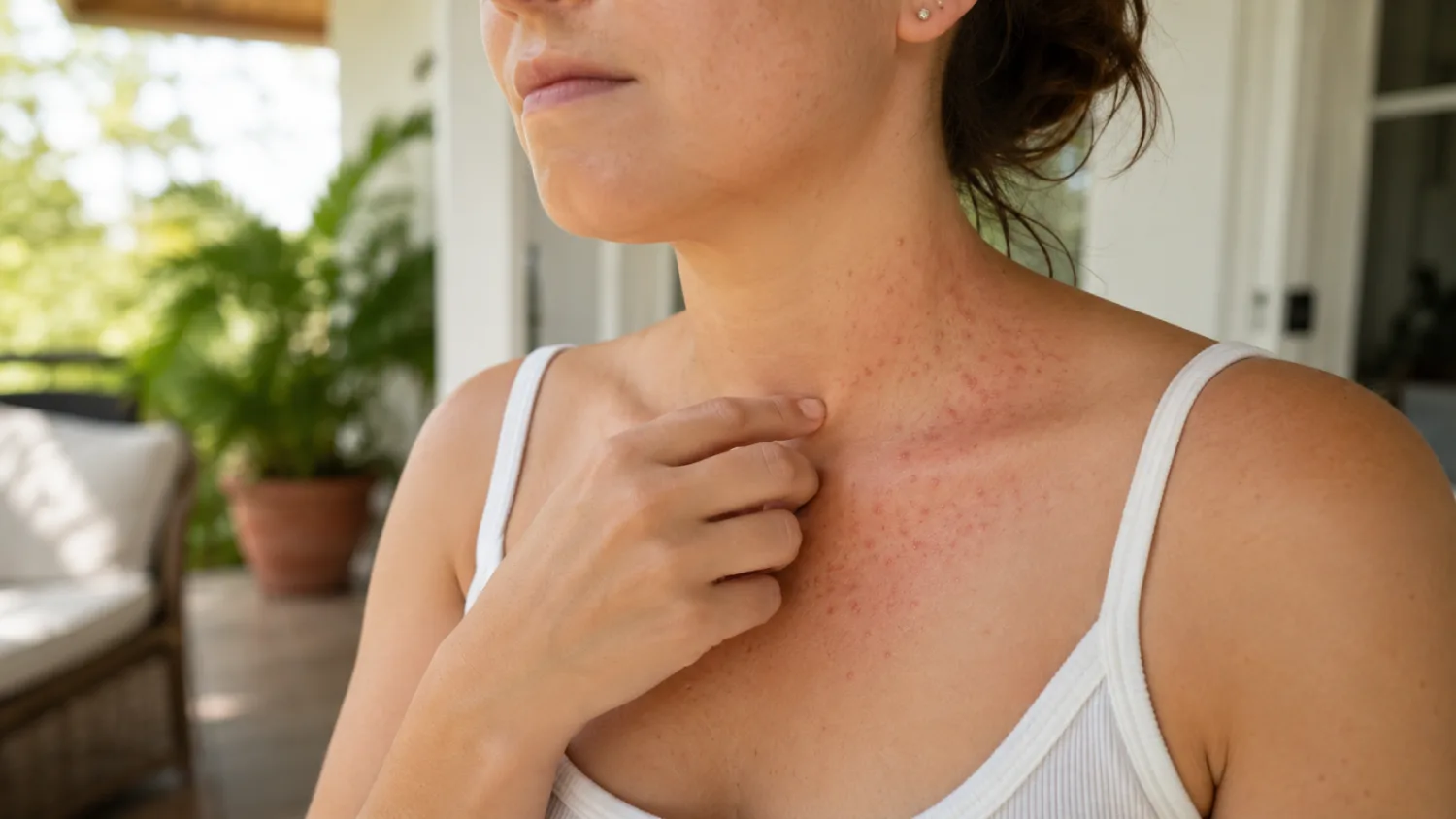
Prickly heat rash is a common skin problem in hot or humid weather. It can cause small itchy bumps, a prickling or stinging feeling, and irritated skin in areas where sweat gets trapped. It is usually harmless and often settles once the skin is cooled, dried and protected from further sweating.
Prickly heat is also called heat rash or miliaria. It can affect adults and children, and it is especially common during heatwaves, holidays, exercise, humid weather, wearing tight clothing, or spending time in warm indoor environments.
This guide explains what prickly heat rash looks and feels like, why it happens, what can help, what to avoid, when to speak to a pharmacist, and when a rash needs medical advice.
Quick answer: Prickly heat rash is usually caused by sweat becoming trapped in the skin during hot or humid conditions. It often causes small raised spots, itching, prickling or stinging. Cooling the skin, wearing loose clothing, avoiding heavy creams and staying out of heat usually helps. Seek advice if the rash is painful, infected-looking, spreading, linked with fever, or not improving.
What is prickly heat rash?
Prickly heat rash happens when sweat ducts become blocked and sweat gets trapped under the skin. This can irritate the skin and cause a rash. It is usually uncomfortable rather than dangerous.
The NHS describes heat rash as uncomfortable but usually harmless, and says it should clear up on its own after a few days. NHS advice includes cooling the skin, using a cold damp cloth or wrapped ice pack for up to 20 minutes, tapping or patting the rash instead of scratching, and avoiding perfumed shower gels or creams. You can read official NHS guidance on heat rash or prickly heat.
Although prickly heat is usually mild, it can be confused with other rashes, such as hives, eczema, contact dermatitis, insect bites, folliculitis, fungal rashes or infection. The pattern, triggers and associated symptoms can help you decide what to do next.
Prickly heat rash symptoms
Prickly heat usually appears in areas where sweat collects, clothing rubs, or skin folds trap heat and moisture.
Common symptoms include:
- small raised bumps or spots
- itching
- prickling, tingling or stinging
- a warm or irritated feeling on the skin
- mild swelling
- redness on lighter skin
- darker, purplish, brown or less obvious colour changes on darker skin
- rash that feels worse when hot or sweaty
The rash may feel more obvious than it looks. On brown or black skin, redness may be harder to see, so it is useful to look for raised bumps, texture changes, itching, heat, swelling or skin that feels different from surrounding areas.
Where does prickly heat usually appear?
Prickly heat can appear anywhere, but it is more common in sweaty or covered areas.
Common places include:
- neck
- chest
- back
- under the breasts
- armpits
- groin
- waistline
- inner thighs
- elbow creases
- behind the knees
- under tight clothing or sportswear
In babies and young children, heat rash may also appear around the neck, shoulders, chest, back, nappy area or skin folds. If a baby has a rash and you are worried, seek medical advice.
What causes prickly heat?
Prickly heat is usually caused by heat, sweat and blocked sweat ducts. Anything that increases sweating or traps moisture against the skin can make it more likely.
Common triggers include:
- hot weather
- humid weather
- exercise
- tight clothing
- synthetic fabrics that trap sweat
- heavy creams, oils or ointments
- bed rest or being under warm bedding
- wearing rucksacks, straps or protective equipment
- working in a hot environment
- holiday heat when your skin is not used to the climate
Prickly heat is not usually caused by poor hygiene. It is mainly about sweat not evaporating properly and skin becoming overheated or blocked.
Why does prickly heat happen in hot weather?
When your body gets hot, it sweats to cool down. If sweat evaporates from the skin, this helps release heat. But if sweat is trapped by clothing, skin folds, humidity or heavy products, the ducts can become blocked and irritated.
This is why prickly heat often happens during:
- UK heatwaves
- hot nights
- summer holidays abroad
- humid days
- exercise or running
- long walks in warm weather
- wearing tight uniforms or workwear
If a rash appears alongside dizziness, nausea, headache, weakness, heavy sweating, thirst or confusion, think about heat illness too. Read Heat Exhaustion and Heatstroke: Symptoms, First Aid and When to Get Help and How to Prevent Heat Exhaustion and Heatstroke in Hot Weather.
Is prickly heat contagious?
No. Prickly heat is not contagious. You cannot catch it from someone else and you cannot pass it on by touching, sharing towels or being nearby.
However, some other rashes can spread between people, such as scabies, impetigo, fungal infections or some viral rashes. If several people in the same household have an itchy rash, or the rash is spreading despite cooling measures, consider getting advice.
How long does prickly heat last?
Prickly heat often improves within a few days once the skin is kept cool and dry. Mild cases may settle faster if you avoid heat, sweating and tight clothing.
It may last longer if:
- the weather remains hot and humid
- you keep sweating heavily
- clothing continues to rub the area
- you scratch the rash
- heavy creams block the skin
- the rash becomes infected
Seek advice if the rash does not improve after a few days, keeps coming back, becomes painful, or you are unsure whether it is prickly heat.
What helps prickly heat rash?
The main treatment is to cool the skin, reduce sweating and avoid blocking or irritating the rash.
Helpful steps include:
- move somewhere cooler
- wear loose, breathable clothing
- choose cotton or moisture-wicking fabrics
- take a cool shower or bath
- pat the skin dry gently
- use a cold damp cloth on the rash
- avoid scratching
- avoid heavy creams, oils or perfumed products
- keep skin folds dry
- avoid intense exercise until symptoms settle
The NHS suggests applying something cold, such as a damp cloth or an ice pack wrapped in a tea towel, for up to 20 minutes. Do not put ice directly on the skin.
What should you avoid?
Some things can make prickly heat worse or slow recovery.
Try to avoid:
- scratching the rash
- hot showers or baths
- heavy moisturisers or oily products
- perfumed shower gels, soaps or creams
- tight clothing
- staying in sweaty clothes after exercise
- too much sun exposure
- thick bedding on hot nights
- using strong steroid creams without advice
Scratching can break the skin and increase the risk of infection. If the itch is strong, ask a pharmacist what may help.
Can a pharmacist help with prickly heat?
Yes. A pharmacist can often help with heat rash, itching and mild skin irritation. They can advise on suitable cooling products, calamine lotion, antihistamines, mild steroid cream if appropriate, or other treatments depending on your symptoms.
Speak to a pharmacist if:
- the rash is itchy and uncomfortable
- you are not sure whether it is prickly heat
- you need advice on creams or antihistamines
- you have sensitive skin or eczema
- you are pregnant
- you are buying treatment for a child
- you take regular medicines and are unsure what is safe
For more about pharmacy advice, see When to See a Pharmacist Instead of a GP.
Do antihistamines help prickly heat?
Antihistamines may help some people if itching is a major symptom, especially at night. However, prickly heat is not the same as an allergy, so antihistamines do not treat the underlying sweat duct blockage. Cooling and reducing sweating are still the most important steps.
Ask a pharmacist before using antihistamines if you are pregnant, breastfeeding, older, taking other medicines, need to drive, or are choosing a medicine for a child.
Does calamine lotion help?
Calamine lotion may feel soothing for some people with itchy heat rash. It can help cool the skin and reduce discomfort. However, it can also dry the skin, so it may not suit everyone, especially people with eczema-prone skin.
Use it as directed and stop if it irritates your skin. Ask a pharmacist if you are unsure.
Should you use steroid cream?
Mild steroid cream may sometimes be suggested for inflamed, itchy skin, but it is not always needed for prickly heat. It may also be unsuitable if the rash is infected, fungal, widespread, on sensitive areas, or in a child without advice.
Ask a pharmacist or GP before using steroid cream if:
- the rash is on the face, groin or genitals
- the skin is broken or infected-looking
- you are treating a child
- you are pregnant
- you have a long-term skin condition
- you are unsure what the rash is
The wrong cream can sometimes make a rash worse, especially if the real cause is fungal infection or bacterial infection.
Prickly heat vs sunburn
Prickly heat and sunburn can happen at the same time, but they are different.
Prickly heat is linked with sweat trapped in the skin. It often causes small itchy bumps or a prickling feeling in sweaty or covered areas.
Sunburn is skin damage caused by ultraviolet radiation. It usually causes hot, sore, tender skin in areas exposed to the sun. It may peel later and can increase long-term skin cancer risk.
Sunburn is not only a holiday problem. It can happen in the UK, including during spring and early summer. For more detail, see Sunburn and Sun Safety: Why Spring Sun Can Still Damage Skin.
Prickly heat vs hives
Hives are usually raised itchy wheals or patches that can change shape, move around and appear suddenly. They may be triggered by allergy, infection, heat, pressure, medicines or unknown causes.
Prickly heat is more likely if the rash appears in sweaty areas during heat or after exercise, and feels prickly or stinging.
Hives may be more likely if:
- the rash comes and goes quickly
- raised patches move around the body
- there is swelling under the skin
- it follows a new food, medicine or sting
- there are allergy symptoms
Call 999 if a rash comes with swelling of the lips, tongue, throat or face, breathing difficulty, wheezing, fainting or collapse. These can be signs of a severe allergic reaction.
Prickly heat vs insect bites
Insect bites often cause individual itchy bumps, sometimes with a visible central puncture mark. They are more likely on exposed areas such as arms, legs, ankles and neck. Prickly heat is usually more widespread in sweaty or covered areas.
Bites may become swollen, sore or infected if scratched. Seek advice if a bite area becomes increasingly painful, hot, swollen, pus-filled, or you develop fever or feel unwell.
For related guidance, see Insect Bites and Stings: Swelling, Infection, Allergy and When to Get Help.
Prickly heat vs contact dermatitis
Contact dermatitis happens when the skin reacts to something it has touched, such as sunscreen, fragrance, detergent, plants, hair dye, nickel, latex, cleaning products or cosmetics.
Contact dermatitis may be more likely if:
- the rash is exactly where a product was applied
- you recently changed sunscreen, soap, detergent or skincare
- the rash is dry, cracked or blistered
- the rash affects the hands, face or area under jewellery
- symptoms keep returning after contact with the same trigger
Heat and sweating can make contact dermatitis worse, so the two can overlap. If you suspect sunscreen or skincare is the trigger, stop using the product and ask a pharmacist for advice.
Prickly heat vs eczema
Eczema can cause dry, itchy, inflamed, cracked or thickened skin. Heat and sweating can trigger eczema flares, so someone with eczema may also develop heat-related irritation.
Eczema is more likely if:
- you have a history of eczema
- the skin is very dry or cracked
- the rash comes and goes over time
- you have known triggers such as soaps, stress or allergens
- the rash affects typical eczema areas such as hands, elbows, knees, face or neck
For more detail, see Eczema and Psoriasis: Symptoms, Differences and Treatment.
Can prickly heat become infected?
Prickly heat itself is not an infection, but scratching can break the skin and allow bacteria in. This can lead to infected skin or folliculitis.
Possible signs of infection include:
- increasing pain
- skin becoming hot, swollen or tender
- pus or yellow crusting
- spreading redness or darker discolouration
- red streaks from the area
- fever
- feeling generally unwell
Seek medical advice if you think the rash may be infected.
When prickly heat is linked with heat exhaustion
Prickly heat is a skin rash. Heat exhaustion is a whole-body heat illness. They can happen in the same hot conditions, but they are not the same.
Watch for heat exhaustion symptoms such as:
- tiredness or weakness
- dizziness
- headache
- feeling sick or vomiting
- heavy sweating
- pale, clammy or unusually hot skin
- muscle cramps
- high temperature
- being very thirsty
The NHS says heat exhaustion does not usually need emergency help if the person can cool down within 30 minutes, but if it turns into heatstroke it should be treated as an emergency. See NHS guidance on heat exhaustion and heatstroke.
Call 999 if someone is confused, not responding normally, has a seizure, has very hot skin, has severe symptoms, or you think they may have heatstroke.
Prickly heat in babies and children
Babies and young children can get prickly heat because their sweat ducts are still developing and they can overheat more easily. They may develop small bumps in skin folds, under clothing, around the neck, chest, back or nappy area.
What may help:
- move the child to a cooler place
- remove extra layers
- use loose, breathable clothing
- keep skin folds clean and dry
- avoid heavy creams unless advised
- offer fluids regularly if age-appropriate
Seek medical advice if your baby is under 3 months and has a fever, the rash does not improve, the child seems very unwell, the rash is purple or does not fade when pressed, or you are worried.
For related childhood rash guidance, see Common Rashes in Children: Causes and Symptoms.
How to prevent prickly heat
Prevention is mainly about reducing overheating and allowing sweat to evaporate.
Practical prevention tips include:
- wear loose, light, breathable clothing
- avoid tight waistbands, straps and synthetic fabrics in hot weather
- shower after sweating
- change out of sweaty clothes quickly
- keep bedrooms cool at night
- avoid heavy creams or oils in hot weather
- use lighter, non-comedogenic skincare if needed
- take breaks during exercise
- stay in shade during the hottest part of the day
- use fans, ventilation or air conditioning where available
During hot weather, prevention is not only about the rash. It is also about avoiding dehydration, heat exhaustion and sunburn. See Dehydration Symptoms in Adults and Children and How to Prevent Heat Exhaustion and Heatstroke in Hot Weather.
Prickly heat on holiday
Many people notice prickly heat on holiday, especially in hot and humid countries. The skin may not be used to the climate, and sweating can increase under sunscreen, swimwear, backpacks, tight clothing or beachwear.
To reduce the risk on holiday:
- choose loose cotton or linen clothing
- avoid sitting in wet swimwear for long periods
- shower after sweating, swimming or using sunscreen
- use lighter sunscreen textures if heavy products trigger irritation
- take breaks in shade or air-conditioned spaces
- avoid intense exercise during the hottest hours
- keep skin folds dry
If the rash is severe, painful, blistering, infected-looking, or linked with fever, seek local medical advice.
Prickly heat at night
Prickly heat can feel worse at night if the room is warm, bedding is heavy, or sweat is trapped against the skin. Itching may also feel more noticeable when you are trying to sleep.
What may help:
- use lighter bedding
- wear loose cotton sleepwear
- keep the room ventilated
- take a cool shower before bed
- avoid heavy creams before sleeping
- use a cool compress before bed
- ask a pharmacist about night-time itch relief if needed
When to contact a GP or NHS 111
Prickly heat usually improves with cooling and self-care. But some rashes need medical advice, especially if they are not behaving like simple heat rash.
Contact a GP, out-of-hours service or NHS 111 if:
- the rash does not improve after a few days
- the rash keeps coming back
- the rash is painful rather than just itchy or prickly
- the rash is spreading quickly
- there are signs of infection
- you have fever or feel unwell
- there is pus, crusting or open sores
- the rash is blistering or peeling
- you are pregnant and worried
- you are immunosuppressed
- the rash affects a baby and you are concerned
- you are not sure what the rash is
You can use NHS 111 online in England if you need urgent advice and it is not a 999 emergency.
For a broader rash guide, see Rash in Adults: Common Causes and When to Seek Urgent Help.
When to call 999
Call 999 if a rash comes with emergency symptoms. This is unlikely to be simple prickly heat.
Call 999 if you or someone else has:
- a rash that does not fade when pressed
- difficulty breathing
- swelling of the lips, tongue, throat or face
- confusion or severe drowsiness
- collapse or fainting
- blue, grey, pale or blotchy skin, lips or tongue
- a stiff neck
- severe headache with fever
- severe symptoms of heatstroke
- rapidly worsening illness
UKHSA hot weather advice says that if symptoms are worsening you should seek medical advice by contacting NHS 111, and in an emergency or if you think someone has heatstroke, dial 999. See UKHSA guidance on staying safe in hot weather.
How to describe the rash to a pharmacist or GP
If you ask for advice, clear details can help the pharmacist or clinician decide whether it sounds like prickly heat or something else.
Useful details include:
- when the rash started
- where it is on the body
- whether it followed heat, sweating or exercise
- whether it is itchy, prickly, painful or burning
- whether there are blisters, pus or crusting
- whether you have fever or feel unwell
- whether the rash fades when pressed
- whether you used a new sunscreen, cream, detergent or medicine
- whether you were bitten or stung
- whether anyone else has a similar rash
- whether you have eczema, allergies or other skin conditions
Frequently asked questions about prickly heat rash
What does prickly heat look like?
Prickly heat often looks like small raised bumps or spots in areas where sweat gets trapped, such as the neck, chest, back, armpits, groin or under the breasts. It may look red on lighter skin, while colour changes may be less obvious or appear darker on brown or black skin.
What does prickly heat feel like?
It often feels itchy, prickly, stinging or tingling. Some people describe it as tiny pins and needles on the skin, especially when they get hot or sweaty.
How long does prickly heat last?
Prickly heat often improves within a few days once the skin is kept cool and dry. It may last longer if you continue sweating, wear tight clothing, scratch the rash or use heavy products that block the skin.
Is prickly heat contagious?
No. Prickly heat is not contagious. It is caused by trapped sweat and blocked sweat ducts, not by an infection that spreads between people.
What is the fastest way to get rid of prickly heat?
Move somewhere cooler, wear loose clothing, take a cool shower, keep the skin dry, use a cold damp cloth for comfort, and avoid scratching or using heavy perfumed creams. A pharmacist can advise if itching is troublesome.
Can you put moisturiser on prickly heat?
Heavy moisturisers, oils and perfumed creams can sometimes make prickly heat worse by blocking the skin. If your skin is dry or eczema-prone, ask a pharmacist about a lighter, suitable product.
Does prickly heat mean I am allergic to the sun?
No. Prickly heat is usually caused by trapped sweat, not sun allergy. However, sunburn, sunscreen reactions and other sun-related rashes can look similar. If the rash happens only after sun exposure or is severe, seek advice.
Can prickly heat happen in the UK?
Yes. It can happen during UK heatwaves, humid weather, exercise, hot workplaces, warm nights or when wearing tight clothing. It is not only a holiday rash.
Can prickly heat affect adults?
Yes. Although babies and children can get it, adults commonly develop prickly heat in hot or humid weather, during exercise, on holiday, or under tight or synthetic clothing.
When should I worry about a heat rash?
Seek advice if the rash is painful, spreading, infected-looking, blistering, peeling, linked with fever, does not improve after a few days, affects a baby and you are worried, or comes with symptoms such as dizziness, confusion, breathing difficulty or severe illness.
Can prickly heat be mistaken for insect bites?
Yes. Insect bites often appear as individual itchy bumps on exposed skin, while prickly heat is usually more widespread in sweaty or covered areas. If swelling, pain, pus or fever develops, seek advice.
Does scratching make prickly heat worse?
Yes. Scratching can irritate the skin, make itching worse and increase the risk of infection. Try tapping or patting the rash instead, and use cooling measures to reduce discomfort.
Final thoughts
Prickly heat rash is common in hot or humid weather and is usually harmless. It happens when sweat becomes trapped in the skin, causing small itchy bumps and a prickling or stinging feeling. Cooling the skin, wearing loose clothing, avoiding heavy creams and reducing sweating usually helps.
However, not every summer rash is prickly heat. Seek advice if the rash is painful, infected-looking, spreading, blistering, linked with fever, not improving after a few days, or if you feel unwell. Call 999 for emergency symptoms such as breathing difficulty, facial or throat swelling, confusion, collapse, a non-blanching rash or suspected heatstroke.
For official guidance, see NHS advice on heat rash or prickly heat, NHS information on heat exhaustion and heatstroke, and UKHSA advice on staying safe in hot weather.
This article is for general information only and should not replace medical advice. If you are worried about your rash or someone else’s symptoms, contact NHS 111, your GP, a pharmacist, or call 999 in an emergency.