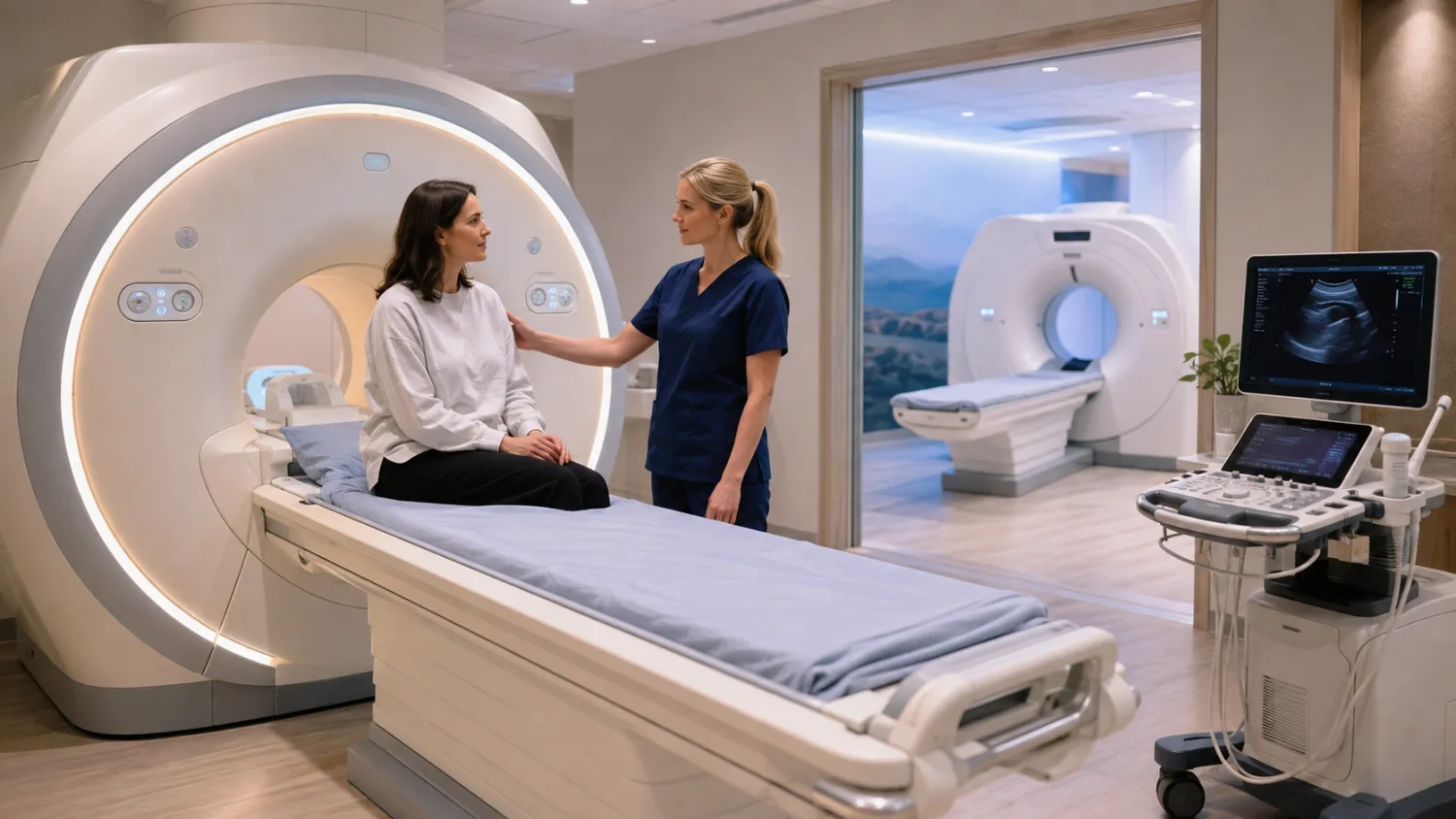
A private MRI, CT or ultrasound scan in the UK can cost anywhere from under £100 to well over £1,000, depending on what is being scanned, the type of imaging, whether contrast is needed and what the quoted price actually includes.
For a straightforward self-pay scan, a useful starting point is roughly £250 to £450 for one-area MRI, £300 to £600 for CT and £120 to £300 for many diagnostic ultrasound scans. More complex examinations can cost considerably more.
Price alone, however, is not the best way to choose a scan.
An MRI, CT and ultrasound do different jobs. Paying £250 for the wrong investigation is not better value than paying £400 for the scan that actually answers the clinical question. Sometimes imaging is not needed at all, and occasionally the safest course is urgent NHS assessment rather than shopping around for a private appointment.
It is also important to distinguish the scan itself from the complete diagnostic pathway. A low headline price may exclude contrast dye, blood tests, a radiologist’s report or a consultation to explain the result. If the scan finds something abnormal, further imaging or a specialist appointment may then generate additional costs.
Our guide to ultrasound vs CT vs MRI explains which type of scan is generally best for different organs, tissues and clinical questions.
Do not arrange a routine private scan instead of urgent medical care if you have symptoms such as sudden weakness on one side, severe new chest pain, major trauma, coughing or vomiting blood, sudden severe abdominal pain, loss of bladder or bowel control, or another possible medical emergency.
Tell the imaging provider before booking if you are or may be pregnant, have significant kidney disease, have previously reacted to contrast dye, have a pacemaker or implanted medical device, or have metal fragments in your body. These issues may affect which scan is appropriate or how it is performed.
A scan should answer a clinical question. Whole-body or broad screening scans can detect harmless incidental findings that lead to anxiety, repeat scans, biopsies or specialist consultations without necessarily improving health.
How much do private MRI, CT and ultrasound scans cost?
There is no national private tariff. Imaging providers set their own prices, and the cost varies according to body area, complexity, location and whether the examination is performed in an independent diagnostic centre or private hospital.
| Private scan | Approximate UK self-pay price |
|---|---|
| MRI – one body area | Around £250–£450 |
| MRI – two body areas | Around £450–£700 |
| MRI with contrast | Around £450–£900+ |
| CT – one body area | Around £300–£600 |
| CT with contrast | Around £450–£800+ |
| CT coronary calcium score | Around £250–£500 |
| Abdominal ultrasound | Around £150–£300 |
| Pelvic ultrasound | Around £150–£350 |
| Musculoskeletal ultrasound | Around £120–£250 |
| Vascular or Doppler ultrasound | Around £200–£450 |
These are useful budgeting ranges rather than guaranteed prices. Some high-volume diagnostic centres advertise MRI scans below £250, while private hospitals in London may charge £500 to £800 or more for an examination that appears similar on paper.
The difference often comes down to what is included.
Why can the same scan have very different prices?
A provider may be quoting:
- only the scan;
- the scan plus radiologist report;
- the scan, report and specialist consultation;
- a promotional price for one simple body area;
- a more complex specialist protocol;
- a scan using contrast;
- an examination performed on a particular type of scanner.
The body area matters too. A standard knee MRI is generally simpler than an MRI involving several parts of the brain, spine or blood vessels.
Do London scans cost more?
Often, yes.
Central London private hospitals and specialist clinics generally have higher overheads and may charge substantially more than independent imaging centres elsewhere.
That does not automatically make the scan clinically better. The important questions are whether the correct protocol is used, the images are of diagnostic quality and an appropriately experienced radiologist reports them.
How much does a private MRI scan cost?
MRI—magnetic resonance imaging—uses a strong magnetic field and radio waves rather than X-rays.
It is particularly useful for many problems involving the:
- brain;
- spine;
- joints;
- muscles and tendons;
- pelvic organs;
- liver and other abdominal organs;
- blood vessels when specialised sequences are used.
For a detailed explanation of the procedure, read our guide to what an MRI scan shows and how to prepare.
One-area MRI
A straightforward scan of one body region commonly costs around £250 to £450.
Examples might include:
- one knee;
- one shoulder;
- lumbar spine;
- cervical spine;
- brain;
- one hip.
Some independent imaging chains advertise scans from around £200 to £250, particularly where self-referral is accepted.
Private hospitals may charge £400 to £700 or more for the same broad body region.
Two or more body areas
Adding another area usually increases the cost but may be cheaper than booking two completely separate scans.
A two-area MRI commonly falls around £450 to £700, while three areas may reach £600 to £900 or more.
Make sure the provider is actually performing the protocol your clinician wants. “Head and neck MRI,” for example, can mean different things depending on whether the clinical question involves the brain, cervical spine, soft tissues or blood vessels.
MRI with contrast
Some MRI examinations require an injection of a gadolinium-based contrast agent to make certain tissues or abnormalities easier to distinguish.
Contrast may be used when investigating:
- tumours;
- inflammation;
- certain neurological conditions;
- previous surgery;
- blood vessels;
- selected liver or abdominal findings.
A contrast MRI may cost approximately £450 to £900 or more.
The contrast charge may already be included or may be an additional £100 to £250 or more.
The NHS notes that MRI contrast reactions are uncommon and serious reactions are rare. People with significant kidney problems may require additional assessment before gadolinium contrast is given.
Open and wide-bore MRI
People with severe claustrophobia may look for an open or wide-bore scanner.
Wide-bore MRI scanners have a larger opening than many older machines and can be more comfortable while still producing high-quality images.
True open MRI scanners are less widely available. Depending on the machine and body area, image quality may differ from that of a high-field conventional scanner.
Specialist or open MRI can sometimes cost more because fewer centres provide it.
Sedation for MRI
If claustrophobia is severe, medication may occasionally be used to help someone relax.
This can create additional costs because:
- a doctor may need to prescribe it;
- monitoring may be required;
- you may need someone to take you home;
- you must not drive afterwards.
Discuss anxiety with the imaging centre before the appointment rather than discovering on the day that the scan cannot be completed.
How much does a private CT scan cost?
CT—computed tomography—uses X-rays and computer processing to create detailed cross-sectional images.
It is fast, which makes it particularly valuable when doctors need a detailed view of the chest, abdomen, bones or internal injury.
Our guide to CT scans, radiation, contrast and how CT differs from MRI covers the procedure in greater detail.
Standard private CT
A one-area private CT commonly costs around £300 to £600.
Published self-pay prices can vary more widely, particularly within private hospitals. Some national private-price data place a single-area CT between roughly £400 and £875 depending on region and provider.
Possible CT examinations include:
- head;
- chest;
- abdomen;
- pelvis;
- sinuses;
- kidneys and urinary tract;
- bones and joints.
CT chest, abdomen and pelvis
Scanning several body regions together will usually cost more than one-area CT.
A chest-abdomen-pelvis CT can cost around £500 to £1,000 or more privately, particularly when intravenous contrast is required.
This type of scan is commonly used when doctors need to investigate cancer, unexplained weight loss or disease affecting more than one body region.
It should not be booked casually as a general “health check” because it involves considerably more radiation than a simple X-ray.
CT with contrast
Iodine-containing contrast dye may be injected into a vein to improve visualisation of organs and blood vessels.
Before the scan, the provider may ask about:
- kidney disease;
- diabetes;
- thyroid problems;
- asthma;
- previous contrast reactions;
- pregnancy;
- current medicines.
You may need a recent kidney-function blood test before contrast is administered.
Our guide to eGFR and creatinine results explains the main blood markers doctors use when assessing kidney function.
CT coronary calcium score
A coronary artery calcium scan is a specialised non-contrast CT that measures calcified plaque in the coronary arteries.
Private prices are commonly around £250 to £500.
It is not the same as CT coronary angiography, which is a more complex scan examining the coronary arteries directly and often costs considerably more.
CT coronary angiography
Private CT coronary angiography may cost approximately £500 to £1,200 or more, particularly when the package includes:
- contrast;
- heart-rate medication;
- ECG monitoring;
- specialist cardiac reporting;
- consultant follow-up.
This is not a suitable screening test for everyone with mild chest discomfort or concern about heart disease. Clinical assessment should come first.
What about radiation?
Unlike MRI and ultrasound, CT uses ionising radiation.
The radiation dose depends greatly on the scan. A CT examination usually delivers more radiation than a standard X-ray because many images are acquired around the body.
The UK Health Security Agency explains that medically justified CT scans carry a relatively small radiation risk compared with the potential benefit of diagnosing an important condition.
The practical principle is simple: CT is extremely valuable when there is a good reason for it, but repeated scans should not be purchased unnecessarily simply because private imaging is available.
How much does a private ultrasound scan cost?
Ultrasound uses high-frequency sound waves rather than radiation.
It is often cheaper than MRI or CT and is particularly good at examining many superficial tissues, abdominal organs, the pelvis and blood vessels.
A straightforward private diagnostic ultrasound commonly costs around £120 to £300.
Our guide to abdominal ultrasound scans explains what the test can and cannot show.
Abdominal ultrasound
An abdominal ultrasound commonly costs around £150 to £300.
It may examine:
- liver;
- gallbladder;
- bile ducts;
- kidneys;
- spleen;
- pancreas where visible;
- abdominal aorta.
It may be requested for abdominal pain, abnormal liver blood tests, suspected gallstones, kidney problems or other symptoms.
Ultrasound does not see every structure equally well. Gas in the bowel, body habitus and the position of organs can limit the examination.
Pelvic ultrasound
A private pelvic ultrasound commonly costs around £150 to £350.
It may involve an external abdominal scan, an internal transvaginal scan or both.
Pelvic ultrasound can help investigate:
- fibroids;
- ovarian cysts;
- abnormal bleeding;
- pelvic pain;
- endometrial thickness;
- selected fertility concerns.
A blood test such as CA125 may occasionally be used alongside imaging when ovarian disease is being investigated. Our guide to CA125 blood-test results explains why an elevated result does not by itself diagnose ovarian cancer.
Musculoskeletal ultrasound
A musculoskeletal ultrasound often costs around £120 to £250.
It is particularly useful for superficial structures such as:
- tendons;
- muscles;
- bursae;
- some ligaments;
- joint fluid;
- cysts.
It may also be used to guide injections.
For some injuries MRI provides much more information. This is why a physiotherapist or doctor may recommend one scan rather than another.
If you are considering imaging for a muscle or joint problem, our guide to private physiotherapy costs in the UK may help you decide whether a clinical assessment should come before paying for a scan.
Vascular and Doppler ultrasound
Doppler ultrasound assesses blood flow.
Private vascular scans commonly cost around £200 to £450, depending on what is being examined.
Examples include:
- carotid arteries;
- leg veins for suspected DVT;
- leg arteries;
- abdominal aorta;
- renal arteries.
A suspected blood clot is not an appropriate reason to wait several days for a cheap private appointment. Sudden one-sided leg swelling or pain, particularly with chest pain or breathlessness, requires urgent medical assessment.
Pregnancy ultrasound
Private pregnancy scans are often cheaper than diagnostic medical ultrasound, with reassurance or early-pregnancy appointments sometimes starting around £60 to £150.
These scans should complement rather than replace NHS antenatal screening.
If pain, heavy bleeding, faintness or concern about ectopic pregnancy is present, seek appropriate medical or early-pregnancy assessment rather than relying only on a commercial reassurance scan.
MRI vs CT vs ultrasound: which scan is actually worth paying for?
The cheapest scan is not necessarily the right scan.
Each technique has particular strengths.
| Scan | Particularly useful for | Main limitation |
|---|---|---|
| MRI | Brain, spinal cord, discs, joints, soft tissues, pelvis | Slower, expensive, metal-device restrictions |
| CT | Chest, lungs, trauma, bones, abdomen, acute bleeding | Uses ionising radiation |
| Ultrasound | Gallbladder, liver, pelvis, pregnancy, superficial tendons, blood vessels | Image quality limited by gas, depth and operator access |
Back pain
MRI is usually the most informative advanced scan when doctors need to examine discs, nerves, the spinal cord or possible infection or tumour.
However, most uncomplicated back pain does not need immediate imaging.
Scans frequently show disc bulges, degeneration and other age-related findings in people who have no pain at all. Imaging is most useful when the result could change treatment.
Abdominal pain
The right scan depends heavily on the suspected cause.
Ultrasound is often useful for:
- gallstones;
- liver problems;
- kidney abnormalities;
- pelvic disease;
- abdominal aortic aneurysm.
CT may be better for:
- appendicitis;
- diverticulitis;
- kidney stones in certain pathways;
- bowel complications;
- trauma;
- many cancers.
MRI may be used when detailed soft-tissue imaging is required or when avoiding radiation is particularly valuable.
Headaches
Not every headache needs a brain scan.
When imaging is justified, MRI is often preferred for many non-emergency neurological questions because it gives detailed images without radiation.
CT is much faster and may be preferred in emergency situations such as suspected acute bleeding or major head injury.
Joint injuries
Ultrasound can be excellent for selected superficial tendon problems.
MRI is better when the clinician needs to assess deeper structures such as:
- menisci;
- cruciate ligaments;
- bone marrow;
- cartilage;
- deep muscle or tendon injury.
Choosing the appropriate test after clinical examination often saves money compared with booking the scan first.
Do you need a GP or consultant referral?
This is one of the biggest differences between providers.
Some private diagnostic centres accept self-referral for selected MRI and ultrasound examinations. Others require a referral from a GP, physiotherapist, consultant or another regulated healthcare professional.
CT is more likely to require a clinical referral because it involves ionising radiation and must be medically justified.
Why do imaging centres ask for a referral?
A referral provides the radiologist with the clinical question.
“MRI knee” is less useful than:
“Persistent medial knee pain after twisting injury six weeks ago; clinical concern regarding medial meniscus tear.”
The clinical information helps the imaging team select the right sequences and helps the radiologist interpret what they see.
Can a physiotherapist refer you?
Sometimes.
Some private imaging centres accept referrals from HCPC-registered physiotherapists for musculoskeletal MRI or ultrasound.
Others require a doctor’s referral, particularly for more complex imaging.
Can you self-refer for MRI?
Some providers allow it.
You may complete a clinical questionnaire which is then reviewed by a clinician before the examination is approved.
Self-referral does not mean every requested scan will be appropriate. A responsible service should recommend another form of assessment when the requested imaging is unlikely to answer the question.
NHS scans
An NHS scan needs to be clinically requested within the NHS pathway.
Depending on the scan and local service, a GP may directly request imaging or refer you to a specialist who then decides whether imaging is needed.
NHS England has expanded GP direct access to several diagnostic tests, including ultrasound, CT and MRI, but access still varies locally.
What does the advertised price actually include?
This is where a £249 scan can become a £600 diagnostic episode.
Before booking, ask for the total self-pay price, not simply the starting price.
Radiologist report
A diagnostic scan should generally result in a written clinical report.
For MRI and CT, this is normally prepared by a radiologist—a doctor specialising in medical imaging.
Ultrasound may be performed and reported by an appropriately trained sonographer or doctor, depending on the examination.
Ask whether reporting is included.
A provider offering images without an appropriate diagnostic report may leave you paying another clinician to interpret them later.
Contrast
Contrast may be charged separately.
The fee can include:
- the contrast agent;
- cannulation;
- additional scan sequences;
- clinical supervision;
- post-scan observation.
Do not assume that you should add contrast simply because it sounds more comprehensive. The radiology protocol should determine whether it is needed.
Kidney blood test
A recent creatinine or eGFR result may be required before certain contrast examinations.
If you do not already have an acceptable recent result, a private blood test may create another charge.
For comparison, see our guide to private blood-test costs in the UK.
Consultant appointment
The radiologist usually writes the report but does not necessarily sit down with you to explain the diagnosis or treatment.
You may need a GP or consultant appointment afterwards.
A private specialist consultation commonly costs around £150 to £300 or more and may therefore represent a significant part of the total diagnostic bill.
Images
Ask whether you will receive:
- online access to the images;
- a download link;
- a CD or USB copy if needed;
- the written radiology report.
If you are likely to return to NHS care afterwards, having both the report and access to the actual images can be useful.
Second-opinion reporting
Complex scans may sometimes require review by a specialist radiologist—for example a neuroradiologist, musculoskeletal radiologist or specialist cancer radiologist.
This can incur an additional fee.
It may be worthwhile when the clinical question is highly specialised or when another specialist needs an expert second opinion on existing images.
NHS vs private scans: is paying privately worth it?
The fundamental imaging technology is not “private” or “NHS”. Both sectors use MRI, CT and ultrasound equipment and appropriately trained radiology professionals.
The main differences are usually access, speed, convenience and what happens around the scan.
Advantages of NHS imaging
NHS imaging is free.
The scan is also embedded in an existing clinical pathway. This means:
- the referring clinician has already assessed why imaging is required;
- the report feeds back into your medical record;
- further investigations can be arranged;
- treatment can continue within the same system.
For urgent suspected cancer, stroke, trauma and other serious conditions, the NHS has specific urgent pathways rather than simply placing everyone in the routine imaging queue.
Why people pay privately
The main reason is usually speed.
Private centres may offer appointments within days, sometimes even the same day.
This can be particularly appealing when someone:
- is waiting for routine NHS imaging;
- wants faster confirmation before deciding on treatment;
- needs imaging before returning to work or sport;
- wants a convenient evening or weekend appointment;
- wants a particular scanner or location.
Will your NHS GP use a private scan?
An NHS clinician can consider relevant private test results, but paying privately does not create an automatic entitlement to NHS treatment, referral or further tests.
The GP must still decide what is clinically appropriate.
This is particularly important with scans arranged without medical referral. The GP may decide that:
- no further action is needed;
- the images need specialist review;
- the scan does not answer the clinical question;
- a different test is required;
- an NHS referral is appropriate.
Private scan, NHS follow-up
It is sensible to ask the private provider:
- when the report will be available;
- whether you receive a copy;
- whether the actual images can be shared;
- how urgent findings are communicated;
- whether the GP can access the images electronically.
This reduces the risk of paying for a scan and then discovering that nobody is clearly responsible for acting on the result.
Our guide to NHS vs private blood tests discusses a similar issue: obtaining a test is only one part of the process; interpretation and follow-up matter just as much.
Private health insurance and scan costs
Private medical insurance commonly covers medically necessary MRI, CT and ultrasound when they are part of an eligible claim.
That does not mean every scan is automatically covered.
You may need authorisation first
Insurers commonly require:
- a GP or consultant referral;
- prior authorisation;
- an approved imaging provider;
- a specific diagnostic code or clinical reason.
If you book first and ask the insurer later, reimbursement may be refused.
Your excess may still apply
If your policy has a £250 excess and the scan costs £350, insurance may only save a relatively small amount during that policy year.
You may also be responsible for:
- co-payments;
- fees above the insurer’s approved rate;
- consultations;
- uncovered conditions;
- screening tests performed without symptoms.
Health screening is often different
Most medical-insurance policies are designed to investigate symptoms or diagnosed conditions rather than fund general screening.
A whole-body MRI or preventative ultrasound booked for reassurance may therefore be excluded.
If you are considering a broader private assessment rather than investigating one symptom, see our guide to private health-check costs in the UK.
Ask both insurer and imaging provider
Before the appointment, confirm:
- the authorisation number;
- the approved provider;
- the approved body area;
- whether contrast is covered;
- whether the radiologist’s fee is included;
- the remaining excess.
Understanding your scan results and what happens next
A private scan feels like a clear endpoint: you pay, have the images and receive a report.
In reality, the report can be the beginning of another diagnostic decision.
Radiologists often describe findings using cautious language because imaging shows appearances rather than always proving a diagnosis.
Common report wording
You may see terms such as:
- unremarkable;
- incidental;
- degenerative;
- benign appearing;
- indeterminate;
- correlate clinically;
- further imaging advised;
- clinical follow-up recommended.
Our guide to understanding MRI, CT, ultrasound and X-ray reports explains these phrases in plain English.
What does “incidental finding” mean?
An incidental finding is something seen that was not the reason the scan was performed.
Examples can include:
- simple kidney cysts;
- small liver cysts;
- benign vertebral changes;
- small thyroid nodules;
- fibroids;
- age-related spinal degeneration.
Many incidental findings need no treatment.
Others require a repeat scan or specialist opinion simply because the radiologist cannot confidently classify them from one examination.
This is one reason indiscriminate whole-body scanning can create more medical activity without necessarily improving health.
What if the report recommends another scan?
Do not assume that the first scan was wasted.
Different imaging methods answer different questions.
An ultrasound might identify a liver lesion but recommend MRI for characterisation. A CT could show a kidney abnormality and suggest targeted ultrasound. MRI may identify a structure that needs comparison with X-ray or CT.
Our guide to understanding medical test results explains why one abnormal test often needs to be interpreted alongside symptoms and other investigations.
How quickly are private results available?
Some providers offer reports within 24 to 48 hours. Others take several working days.
A same-day scan does not necessarily mean a same-day radiology report.
NHS guidance notes that MRI and CT results can routinely take around one to two weeks because the images must be formally interpreted by a radiologist.
Private providers often shorten this reporting stage, but verify the promised turnaround before booking if speed is the reason you are paying.
Who contacts you if something serious is found?
This is an important question for self-referral services.
Ask before booking:
“If the radiologist finds something that requires urgent medical attention, who contacts me and my GP?”
A responsible diagnostic service should have an escalation procedure for urgent or unexpected findings.
How to choose a private imaging provider
Price transparency is useful, but diagnostic quality matters more.
You should know who requested or approved the examination, who performs it and who writes the report.
Check exactly what you are booking
Confirm:
- the body area;
- MRI, CT or ultrasound;
- whether contrast might be required;
- whether the radiologist report is included;
- reporting turnaround;
- whether you receive the images;
- the total self-pay cost.
Do not choose by scanner strength alone
MRI providers may advertise 1.5 Tesla or 3 Tesla scanners.
A higher magnetic-field strength can offer advantages for certain examinations, but 3T is not automatically better for every patient or every clinical problem.
The scan protocol and radiologist’s expertise often matter more than one headline technical specification.
Check who reports the scan
Many providers use radiologists with particular subspecialist expertise.
Examples include:
- neuroradiology;
- musculoskeletal radiology;
- gastrointestinal imaging;
- cardiac imaging;
- breast imaging.
A specialist report can be particularly valuable for complex conditions.
Beware of unnecessary “full body” packages
Commercial whole-body MRI packages are increasingly promoted as reassurance screening.
The attraction is obvious: scan everything and find disease early.
The difficulty is that healthy bodies contain numerous harmless abnormalities. A broad scan can uncover findings that lead to:
- repeat MRI;
- CT radiation;
- specialist appointments;
- biopsies;
- anxiety;
- additional private costs.
It can also miss diseases that are better detected using another screening method.
A normal whole-body MRI does not replace established programmes such as cervical screening, breast screening, bowel screening or appropriate blood-pressure and cardiovascular assessment.
Keep your report and images
Download or request copies.
If another doctor later needs to review the investigation, access to the original images can prevent unnecessary repeat scanning.
Frequently asked questions about private scan costs
How much does a private MRI cost in the UK?
A straightforward one-area MRI commonly costs around £250 to £450, although private-hospital and specialist examinations can cost considerably more.
How much does a private CT scan cost?
A one-area CT commonly costs around £300 to £600. Contrast and multi-area scans may raise the price to £800 or more.
How much does a private ultrasound cost?
Many diagnostic ultrasound scans cost around £120 to £300.
Which scan is cheapest?
Ultrasound is generally the least expensive of the three, but it cannot answer every clinical question.
Why is MRI more expensive?
MRI equipment is expensive to purchase and operate, scans can take considerably longer than CT or ultrasound, and specialist reporting is required.
Why can CT cost more than MRI?
Complex CT protocols, contrast, several body regions, cardiac imaging and hospital pricing can make CT more expensive than a basic MRI.
Does the scan price include the report?
Often, but not always. Confirm that a formal diagnostic report is included before booking.
Does the price include contrast?
Not necessarily. Contrast may add approximately £100 to £250 or more.
Do I need contrast?
Only when it adds clinically useful information. The imaging protocol should determine whether contrast is required.
Can I ask for contrast because I want a more detailed scan?
It is not simply an optional upgrade. Contrast should be used when medically justified.
Do I need a blood test before contrast?
You may need kidney-function testing before certain MRI or CT contrast examinations, particularly if you have kidney disease or relevant risk factors.
Is MRI safer than CT?
MRI does not use ionising radiation, while CT does. MRI has its own safety considerations involving implants, metal and contrast.
Does ultrasound use radiation?
No. Diagnostic ultrasound uses sound waves.
Does MRI use radiation?
No.
Does CT use radiation?
Yes. CT uses X-rays.
Is CT radiation dangerous?
The risk from a medically justified scan is generally small. Unnecessary repeated CT examinations should still be avoided.
Can I pay for an MRI without seeing a GP?
Some private providers accept self-referrals for selected scans.
Can I self-refer for CT?
It is less common because CT uses ionising radiation and requires formal medical justification.
Can I self-refer for ultrasound?
Many private ultrasound providers accept self-referrals for selected examinations.
Can my physiotherapist refer me for MRI?
Some imaging centres accept referrals from HCPC-registered physiotherapists, particularly for musculoskeletal scans.
Can my NHS GP refer me to a private scan?
You can discuss it with your GP, but practices differ in how they handle private referrals and forms.
Can I pay privately and then return to the NHS?
Yes. However, NHS clinicians will independently decide what follow-up is clinically appropriate.
Will my GP accept the private scan report?
They can consider it, but they may need the images, specialist review or further NHS investigation depending on the finding.
Will a private scan appear in the NHS App?
Not automatically. It may appear later if the report is sent to and added by your GP surgery.
Can I request my MRI or CT images?
Yes. Ask the provider how you can obtain or share them.
How quickly can I get a private scan?
Some centres offer appointments within one or two days, depending on the examination and location.
How quickly are private results available?
Many providers report within one to three working days, although this varies.
Will I get the result during an ultrasound?
Sometimes the sonographer or doctor may discuss the findings, but in other services you receive a formal report later.
Will the MRI radiographer tell me what they saw?
Usually not. The images normally need formal review by a radiologist.
Can the scan centre diagnose me?
The radiologist reports imaging findings. Your referring clinician usually combines the report with symptoms, examination and other tests to reach a diagnosis.
How much is a brain MRI?
A standard private brain MRI may cost approximately £250 to £500, with specialist sequences or contrast increasing the price.
How much is a spine MRI?
One spinal region may cost around £250 to £450. Scanning cervical, thoracic and lumbar regions together costs substantially more.
How much is a knee MRI?
A private knee MRI commonly costs around £250 to £450.
How much is an abdominal MRI?
Abdominal MRI is often more complex and may cost around £350 to £700 or more, especially with contrast.
How much is an abdominal CT?
A private abdominal CT commonly costs around £350 to £700, depending on contrast and provider.
How much is a CT chest?
A private CT chest may cost roughly £300 to £600.
How much does CT coronary angiography cost?
It may cost around £500 to £1,200 or more.
How much does an abdominal ultrasound cost?
Approximately £150 to £300 is common.
How much does a pelvic ultrasound cost?
Approximately £150 to £350.
How much does a musculoskeletal ultrasound cost?
Often around £120 to £250.
How much does a vascular ultrasound cost?
Specialist Doppler examinations may cost around £200 to £450.
Is a private scan covered by medical insurance?
Often, when medically necessary and authorised in advance. Screening scans may be excluded.
Will I pay an insurance excess?
Possibly. This depends on your policy.
Can I claim a self-referred scan from insurance?
Do not assume so. Many insurers require a clinical referral and prior authorisation.
Is a whole-body MRI worth it?
It may detect abnormalities, but routine screening of healthy people can also produce incidental findings and unnecessary follow-up. It does not replace established screening programmes.
Can MRI detect cancer everywhere?
No. Different cancers require different tests, and some small or early cancers may not be detected on a general MRI.
Can ultrasound detect cancer?
It can identify suspicious masses in some organs but usually cannot confirm cancer by itself.
Can CT diagnose cancer?
CT can identify abnormalities highly suspicious for cancer and assess spread, but tissue biopsy is often required for a definitive diagnosis.
Can a scan be normal even when something is wrong?
Yes. Every imaging method has limitations, and some conditions do not produce visible changes on the chosen scan.
What happens if the scan finds something unexpected?
The radiologist may recommend clinical review, another type of scan, repeat imaging, blood tests or specialist referral.
What does “clinical correlation advised” mean?
It means the imaging appearance should be interpreted alongside symptoms, physical examination and other information before deciding what it represents.
Should I repeat a private scan if my symptoms continue?
Not automatically. Persistent symptoms should be clinically reassessed so the correct next investigation can be chosen.
Is a cheap MRI safe?
Price alone does not determine safety or quality. Check the provider, scanner suitability, referral process and reporting arrangements.
What should I ask before booking?
Ask what scan you are receiving, whether the report and contrast are included, who reports it, when results will arrive, how urgent findings are handled and what the total price will be.