A scale and polish is one of the most familiar dental treatments in the UK, but it is also one of the most misunderstood. Many people think it is a routine “clean” they should automatically get at every NHS check-up. Others are told they need to book privately with a hygienist and feel unsure whether they are being upsold.
The truth is more nuanced. A scale and polish can be part of NHS care if it is clinically necessary. If it is mainly for cosmetic stain removal, freshening up the mouth, or having a longer hygiene appointment when there is no clinical need, it is usually private. Private hygienist appointments may also offer more time, more detailed gum advice, airflow polishing, stain removal and maintenance around crowns, bridges, implants, dentures or aligners.
This guide explains what a scale and polish is, how NHS and private cleaning differ, when NHS scaling should be available, typical private costs, what happens during treatment, when you may need deeper gum cleaning, and what questions to ask before paying.
If you want a wider guide to hygiene visits, read our full article on Dental Hygienist Appointments Explained. You may also find our guides to bleeding gums and gum disease, what makes a good dental practice, how to choose a dentist in the UK, dental crowns, dental bridges, dentures and clear aligners useful.
Quick summary
- A scale and polish removes plaque, tartar and some surface stains from the teeth.
- NHS scaling is available if your dental professional says it is clinically necessary.
- If scaling is not clinically necessary and you want it for cosmetic or freshness reasons, you usually need to pay privately.
- In England, NHS Band 1 is £27.90 from 1 April 2026 and may include a scale and polish if clinically needed.
- More extensive gum treatment or treatment for complex gum problems may be charged as NHS Band 2, which is £76.60 from 1 April 2026.
- Private scale and polish or hygienist appointments commonly cost around £60 to £150+, depending on appointment length and what is included.
- A routine scale and polish is not the same as deep periodontal cleaning for gum disease.
- Airflow polishing can remove surface staining, but it is not the same as teeth whitening.
- If you have bleeding gums, bad breath, loose teeth, gum recession or repeated tartar build-up, you may need more than a cosmetic clean.
What is a scale and polish?
A scale and polish is a dental cleaning treatment. The “scale” part removes plaque and tartar from the teeth, especially around the gumline and between teeth. The “polish” part smooths the tooth surfaces and removes some surface stains.
Plaque is the soft, sticky film of bacteria that forms on teeth every day. If plaque is not removed properly, it can harden into tartar, also called calculus. Once tartar has formed, you cannot remove it with normal brushing. It needs professional cleaning.
A scale and polish may help with:
- Tartar build-up.
- Rough-feeling teeth.
- Surface stains from tea, coffee, red wine or smoking.
- Bleeding gums caused by plaque build-up.
- Bad breath linked to plaque or gum inflammation.
- Cleaning around crowded teeth, crowns, bridges, dentures, implants or braces.
It is important to understand that a scale and polish does not cure every dental problem. It will not repair decay, fix a broken tooth, treat a deep abscess or whiten the natural shade of your teeth. It is mainly about cleaning, prevention and gum health.
Is scale and polish available on the NHS?
Yes, but only when it is clinically necessary. The NHS explains that if your dental healthcare professional says scaling is clinically needed, you can get it on the NHS. It can be done by a hygienist or dental therapist. Scaling is usually included in Band 1, but extensive treatment or treatment for complex gum problems may be charged as Band 2. If the dentist says scaling is not clinically necessary, you will have to pay for it privately. You can read this on the NHS dental treatment costs page.
In England, from 1 April 2026:
- Band 1: £27.90. This may include examination, diagnosis, X-rays if needed, preventive advice and a scale and polish if clinically necessary.
- Band 2: £76.60. This includes Band 1 care plus further treatment such as fillings, root canal treatment, extractions and more complex gum treatment where appropriate.
- Band 3: £332.10. This includes more complex custom-made treatments such as crowns, dentures and bridges.
NHS fees are different in Scotland, Wales and Northern Ireland, and exemptions or help with costs may apply. Always check the latest NHS guidance for your nation.
Why do some people not get a scale and polish on the NHS?
The NHS does not provide every treatment simply because a patient wants it. NHS dental care is based on clinical need.
You may not be offered an NHS scale and polish if your dentist decides it is not clinically necessary. For example, if your gums are healthy, there is little tartar, and you mainly want stain removal or a “fresh clean”, the dentist may explain that this is private hygiene care.
However, if you have tartar build-up, gum inflammation, bleeding, periodontal pockets or other clinical signs that scaling is needed, it may be appropriate within NHS care.
NHS scale and polish vs private scale and polish
NHS and private scale and polish appointments can both be clinically useful, but they often differ in purpose, time, flexibility and what is included.
| Feature | NHS scale and polish | Private scale and polish |
|---|---|---|
| Main purpose | Clinically necessary scaling or gum care | Can include prevention, maintenance, stain removal and longer hygiene care |
| Availability | Only if clinically needed | Usually available if you choose to pay privately |
| Cost in England | Usually Band 1 at £27.90, or Band 2 at £76.60 for more extensive gum treatment | Commonly around £60 to £150+, depending on time and treatment |
| Appointment length | Based on clinical need and NHS appointment structure | Often longer, with 20, 30, 45 or 60-minute options |
| Stain removal | May be limited if not clinically necessary | Often more focus on stain removal, polishing and cosmetic finish |
| Airflow polishing | Usually not routinely available on the NHS | Often available privately, sometimes at extra cost |
| Gum disease care | Available when clinically needed | May offer longer or more frequent periodontal maintenance appointments |
| Choice and convenience | Depends on NHS access and practice capacity | More flexibility in timing, length and extras |
Does NHS Band 1 always include a scale and polish?
No. Band 1 can include a scale and polish if it is clinically necessary. It does not mean every NHS check-up automatically includes one.
This is one of the biggest causes of confusion. A patient may remember always having a scale and polish years ago and expect it every time. But under NHS rules, the key point is clinical need.
If you are not offered scaling and you think you need it, ask calmly:
- Do I have tartar build-up?
- Are my gums bleeding or inflamed?
- Is scaling clinically necessary for me?
- If not, why not?
- Would private hygienist care be optional rather than necessary?
How much does a private scale and polish cost?
A private scale and polish or hygienist appointment in the UK commonly costs around £60 to £150+. The price depends on appointment length, clinic location, whether airflow polishing is included, and whether the appointment is routine cleaning or gum disease treatment.
| Private hygiene appointment | Typical UK cost range | What it may include |
|---|---|---|
| Short hygiene appointment | £50 to £80+ | Light scaling, polishing and basic advice |
| Standard hygienist appointment | £60 to £110+ | Routine scale and polish, gum advice and interdental cleaning advice |
| Longer hygienist appointment | £90 to £150+ | More time for heavier tartar, stain removal or detailed advice |
| Airflow polish appointment | £80 to £180+ | Stain and biofilm removal using air, water and powder |
| Deep gum cleaning or periodontal treatment | £120 to £300+ per session | More intensive gum disease treatment, often over multiple visits |
These are broad guide prices only. Some dental plans include routine hygienist visits for a monthly fee, while others charge per visit.
Why is private hygiene treatment more expensive?
Private hygienist care usually costs more because the fee reflects appointment time, staffing, equipment, materials, premises, regulation and flexibility. Private appointments may also offer more choice over appointment length and additional stain removal options.
A private appointment may include:
- Longer time with the hygienist.
- More detailed gum assessment.
- Personalised brushing and interdental cleaning advice.
- Stain removal beyond what is clinically required.
- Airflow polishing.
- Maintenance around implants, bridges, crowns or orthodontic appliances.
- More frequent appointments than NHS care would provide.
This does not mean everyone needs private hygiene care. But for some people, especially those with staining, gum disease risk, dental implants, orthodontics or anxiety, the extra time can be useful.
What happens during a scale and polish?
A scale and polish appointment usually follows a simple structure, although the exact approach depends on your mouth.
1. Gum and plaque check
The dentist, hygienist or therapist may look at your gums, plaque levels, tartar build-up and bleeding. If gum disease is suspected, they may measure gum pockets.
2. Scaling
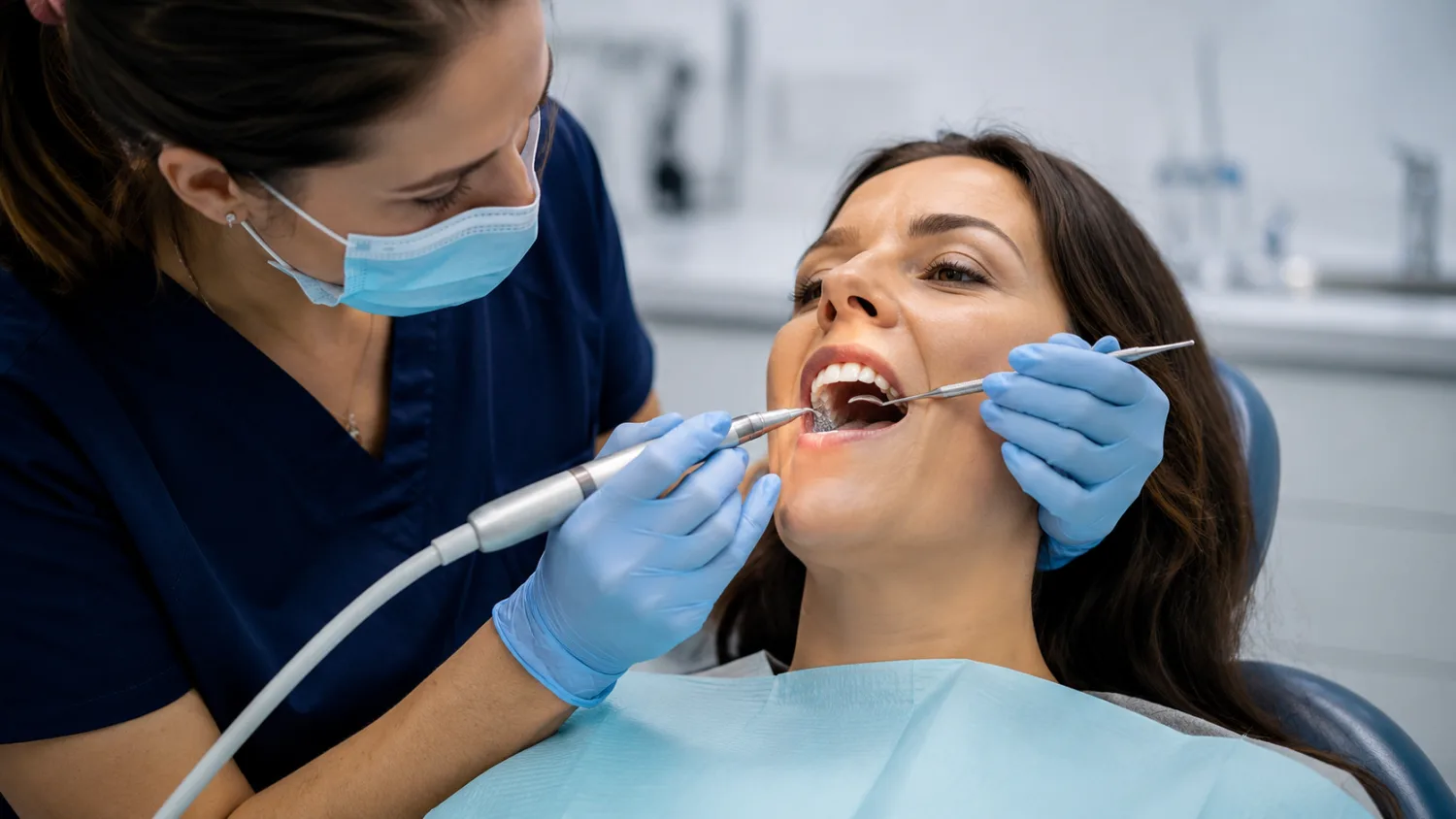
Scaling removes tartar and plaque from tooth surfaces and around the gumline. This may be done using an ultrasonic scaler, hand instruments, or both.
3. Polishing
Polishing smooths the tooth surface and removes some external staining. It can make teeth feel cleaner and less rough.
4. Oral hygiene advice
Good advice is a major part of the appointment. You may be shown how to brush more effectively, which interdental brushes to use, and where plaque is building up.
5. Follow-up plan
Depending on your gums, you may be advised to return in 3, 6 or 12 months, or to see a dentist for further assessment.
Does a scale and polish hurt?
A routine scale and polish may feel uncomfortable but should not be very painful. You may feel vibration, scraping, water spray or tenderness around inflamed gums.
It may be more uncomfortable if:
- You have sensitive teeth.
- Your gums are inflamed.
- There is heavy tartar build-up.
- You have gum recession.
- You have deeper gum pockets.
- You have not had a cleaning appointment for a long time.
Tell the hygienist or dentist if you are nervous or sensitive. For deeper gum treatment, local anaesthetic may sometimes be used.
Is bleeding normal during a scale and polish?
Bleeding can happen if gums are inflamed. Healthy gums usually bleed less. If plaque and tartar have caused gum inflammation, bleeding during cleaning is common.
Bleeding should improve as plaque control improves. Do not stop brushing because your gums bleed. In many cases, bleeding gums need better cleaning, not less cleaning.
If your gums bleed regularly, read our guide: Bleeding Gums and Gum Disease: Causes and Treatment.
Scale and polish vs deep cleaning
A routine scale and polish is not the same as deep cleaning for gum disease.
A routine scale and polish usually removes tartar and plaque from visible tooth surfaces and around the gumline. It is often used for maintenance, early gum inflammation or stain removal.
Deep cleaning, also called periodontal cleaning or root surface debridement, is used when gum disease has created deeper pockets around teeth. It involves cleaning below the gumline and may require longer appointments, local anaesthetic and follow-up checks.
| Feature | Scale and polish | Deep gum cleaning |
|---|---|---|
| Purpose | Routine maintenance, tartar and surface stain removal | Treatment of gum disease and deeper deposits |
| Depth | Mainly around visible teeth and gumline | Below the gumline in periodontal pockets |
| Appointment length | Often shorter | Often longer or split over several visits |
| Anaesthetic | Usually not needed | May be needed for comfort |
| NHS band in England | Usually Band 1 if clinically necessary | May be Band 2 if more extensive or complex |
What is airflow polishing?
Airflow polishing uses a controlled stream of air, water and fine powder to remove surface stains and soft biofilm. It is often offered privately.
Airflow may be useful for:
- Tea, coffee or red wine staining.
- Smoking stains.
- Stain around orthodontic attachments or retainers.
- Cleaning around some dental restorations.
- Patients who want a smoother, fresher-feeling clean.
Airflow is not the same as teeth whitening. It can remove external stains and make teeth look brighter, but it does not change the natural internal shade of the tooth.
If your main concern is tooth colour, read: Teeth Whitening in the UK: Options, Safety and Costs.
Can a scale and polish whiten teeth?
A scale and polish can remove some surface stains, so teeth may look cleaner and brighter afterwards. But it does not bleach the teeth.
If teeth are yellow because of their natural shade, ageing, internal staining or previous dental work, a scale and polish will not dramatically whiten them. Professional whitening, bonding, veneers or replacement restorations may be discussed depending on the cause.
Be cautious of any claim that a simple scale and polish will whiten teeth like bleaching. It is a cleaning treatment, not a whitening treatment.
Who benefits most from private hygienist care?
Private hygienist appointments can be helpful for many people, but they are especially useful if you need more time, more frequent maintenance or stain removal beyond clinical need.
You may benefit from private hygiene care if you have:
- Frequent tartar build-up.
- Bleeding gums.
- Gum disease maintenance needs.
- Dental implants.
- Crowns, bridges or dentures.
- Fixed braces or clear aligners.
- Heavy tea, coffee, red wine or smoking stains.
- Bad breath linked to plaque or gum inflammation.
- Dental anxiety and need a slower appointment.
- Difficulty cleaning because of dexterity issues.
Scale and polish if you have gum disease
If you have gum disease, a routine scale and polish may not be enough. Gum disease can involve deeper pockets where bacteria and tartar collect below the gumline.
Gum disease care may involve:
- Detailed gum measurements.
- Bleeding and plaque scores.
- Deep cleaning below the gumline.
- Local anaesthetic if needed.
- Smoking advice.
- Interdental cleaning instruction.
- Regular periodontal maintenance.
- Referral to a periodontist in advanced cases.
If your teeth feel loose, gums are receding, or you have been told you have bone loss, ask whether you need periodontal treatment rather than a standard scale and polish.
Scale and polish if you have crowns, bridges or dentures
Crowns, bridges and dentures need careful maintenance. A scale and polish can help clean around natural teeth and restorations, but you also need the right home-care tools.
If you have a bridge, you may need superfloss, floss threaders or interdental brushes to clean underneath. If you have crowns, cleaning around the gumline is important because decay can still develop at the crown edge. If you wear partial dentures, cleaning around clasps and remaining teeth helps reduce decay and gum problems.
Related guides: Dental Crowns Explained, Dental Bridges Explained and Dentures in the UK.
Scale and polish if you have implants
Dental implants need careful cleaning and maintenance. Although implants cannot decay, the tissues around them can become inflamed. This can lead to problems such as peri-implant mucositis or peri-implantitis.
Hygienists may use specific instruments and cleaning techniques around implants. If you have implants, ask your dental team how often you should have maintenance appointments and which interdental brushes or other tools are safe for you.
Read more: Dental Implants in the UK.
Scale and polish if you have braces or clear aligners
Orthodontic treatment can make cleaning more important. Fixed braces create plaque traps around brackets and wires. Clear aligners can trap sugar, acid and plaque against the teeth if oral hygiene is poor.
A hygienist can help with:
- Cleaning around brackets and wires.
- Reducing plaque build-up during aligner treatment.
- Advice on interdental brushes.
- Reducing the risk of white marks.
- Cleaning around attachments and retainers.
Read more: Invisalign and Clear Aligners in the UK.
How often should you have a scale and polish?
There is no perfect schedule for everyone. Some people need hygienist care every 3 months. Others may only need it every 6 to 12 months.
More frequent cleaning may be recommended if you have:
- Gum disease.
- Bleeding gums.
- Heavy tartar build-up.
- Diabetes.
- Smoking or vaping habits.
- Dry mouth.
- Dental implants.
- Crowns, bridges or dentures.
- Orthodontic appliances.
- Difficulty cleaning effectively at home.
Ask your dentist or hygienist what interval is right for you. A fixed “every six months” rule may be too often for some people and not often enough for others.
Is a private hygienist appointment worth it?
It can be, depending on what you need. Private hygiene care may be worth it if you want longer appointment time, more detailed advice, airflow stain removal, regular gum maintenance or easier access.
It may be less necessary if your gums are healthy, you have little tartar, you clean well at home and you are not bothered by surface staining.
A good dental practice should explain whether hygiene care is clinically needed, optional, cosmetic or part of gum disease treatment. If you are unsure, ask.
Can you remove tartar at home?
No. Once plaque hardens into tartar, it needs professional removal. Do not use sharp tools, metal scrapers or online tartar removal devices at home. You can damage enamel, injure gums or push bacteria under the gumline.
At home, focus on preventing new tartar by brushing twice daily with fluoride toothpaste and cleaning between your teeth every day.
What should you do after a scale and polish?
After a scale and polish, teeth may feel smooth and gums may be slightly tender. Mild bleeding or sensitivity can happen, especially if gums were inflamed.
Aftercare tips include:
- Continue brushing twice daily with fluoride toothpaste.
- Clean between teeth as advised.
- Do not stop cleaning if gums bleed slightly at first.
- Use sensitivity toothpaste if advised.
- Avoid smoking if possible, especially after deeper gum treatment.
- Follow any advice about mouthwash, interdental brushes or follow-up visits.
- Contact the practice if pain, swelling or bleeding is severe or worsening.
Can a scale and polish make teeth sensitive?
Temporary sensitivity can happen after scaling, especially if tartar was covering exposed root surfaces or gums were inflamed. Sensitivity usually settles, but it can be uncomfortable for a few days.
Ask your dental team about:
- Sensitivity toothpaste.
- Fluoride varnish.
- Gentle brushing technique.
- Managing gum recession.
- Avoiding very cold drinks for a short time.
Can a scale and polish damage teeth?
Professional scaling by a trained dental professional is generally safe when clinically appropriate. It removes deposits that can contribute to gum inflammation and disease.
However, aggressive DIY scraping at home can damage teeth and gums. If you are worried that cleaning feels too uncomfortable or frequent, ask your hygienist to explain what they are doing and why.
What questions should you ask before paying privately?
If you are offered private scale and polish or hygienist care, ask:
- Is scaling clinically necessary for me?
- Is any of this available on the NHS?
- What is included in the private appointment?
- How long is the appointment?
- Is airflow included or extra?
- Do I have gum disease?
- Do I need routine cleaning or deep gum treatment?
- How often do I need to come back?
- What can I do at home to reduce future tartar?
- Will I receive advice on interdental brushes or floss?
Red flags to watch out for
Be cautious if:
- You are told every patient must pay privately for a clean without explanation.
- The practice does not explain whether scaling is clinically necessary.
- You are not told the cost before treatment.
- Bleeding gums are dismissed without a gum assessment.
- You receive repeated polishing but no advice on plaque control.
- Airflow is sold as whitening.
- You are not told whether you need deep gum treatment rather than a routine clean.
- The practice does not explain NHS and private options clearly.
When should you see a dentist rather than only a hygienist?
A hygienist appointment is not a replacement for a dental examination. See a dentist if you have:
- Toothache.
- A broken tooth.
- A lost filling or crown.
- Facial swelling.
- A dental abscess.
- Loose teeth.
- Persistent ulcers.
- Bleeding that does not improve.
- Bad breath that does not improve with cleaning.
- Visible decay or holes in teeth.
For urgent problems, read: Swollen Face from a Tooth: When It Is an Emergency, Lost Filling or Crown: What to Do, Broken Tooth: What to Do and Wisdom Tooth Pain and Removal.
Final thoughts
A scale and polish can be a simple, useful part of dental care, but whether it is NHS or private depends on clinical need. If scaling is needed for your gum health, it should be available on the NHS. If you want extra cleaning, stain removal, airflow polishing or longer hygiene care when there is no clinical need, that is usually private.
The best appointment is not always the cheapest or the most polished. It is the one that helps you understand your gums, remove harmful deposits, improve your home cleaning and prevent bigger dental problems later.
If you are unsure why you are being offered NHS or private treatment, ask. A good dental practice should be able to explain the difference clearly.
For more patient-friendly dental guides, visit our Dental Health & Dentistry section.
Frequently asked questions about scale and polish
What is a scale and polish?
A scale and polish is a dental cleaning treatment that removes plaque, tartar and some surface stains from teeth, then polishes the tooth surfaces.
Is scale and polish available on the NHS?
Yes, if your dental professional says it is clinically necessary. If it is not clinically necessary, you may need to pay privately.
How much is an NHS scale and polish?
In England, scaling is usually included in Band 1 if clinically necessary, which is £27.90 from 1 April 2026. More extensive or complex gum treatment may be Band 2 at £76.60.
Does every NHS check-up include a scale and polish?
No. A scale and polish is included only if clinically necessary. It is not automatically included at every check-up.
How much is a private scale and polish?
Private appointments commonly cost around £60 to £150+, depending on appointment length, clinic location and whether extras such as airflow polishing are included.
Why did my dentist say I need to pay privately for a clean?
If scaling is not clinically necessary and you mainly want stain removal or a fresher clean, it may be considered private treatment. Ask the dentist to explain whether there is a clinical need.
Can a hygienist do NHS scaling?
Yes. NHS scaling can be done by a hygienist or dental therapist if it is clinically needed and arranged within NHS care.
Is private scale and polish better than NHS?
Not automatically. NHS scaling is based on clinical need. Private appointments may offer more time, flexibility and stain removal options, but they are not always necessary for everyone.
What is the difference between scale and polish and deep cleaning?
A scale and polish usually cleans around the visible teeth and gumline. Deep cleaning treats gum disease by cleaning deeper below the gumline in periodontal pockets.
Does scale and polish hurt?
It may feel uncomfortable, especially if gums are inflamed or teeth are sensitive, but it should not be very painful. Tell your hygienist or dentist if you are worried.
Why do my gums bleed during scale and polish?
Bleeding usually means the gums are inflamed. As plaque control improves, bleeding often reduces.
Should I stop brushing if my gums bleed?
No. Bleeding gums usually need better cleaning, not less. Ask your hygienist to show you the best technique.
Can scale and polish whiten teeth?
It can remove surface stains and make teeth look brighter, but it does not bleach teeth or change their natural internal colour.
What is airflow polishing?
Airflow polishing uses air, water and fine powder to remove surface stains and biofilm. It is usually a private treatment or private add-on.
Is airflow the same as whitening?
No. Airflow removes external stains. Whitening changes the shade of the tooth using whitening gel under dental professional care.
Can scale and polish remove tartar?
Yes. Removing tartar is one of the main purposes of scaling.
Can I remove tartar myself?
No. Do not scrape tartar yourself with sharp tools. You can damage teeth and gums. Tartar should be removed professionally.
How often should I have a scale and polish?
It depends on your gum health and risk. Some people need hygiene care every 3 months, while others may only need it every 6 to 12 months.
Do smokers need more frequent scale and polish appointments?
Smokers often have more staining and a higher risk of gum disease, so more frequent hygienist appointments may be recommended.
Can scale and polish help bad breath?
It can help if bad breath is linked to plaque, tartar or gum inflammation. Persistent bad breath should be assessed by a dentist.
Can scale and polish help gum disease?
It can help with gum inflammation and maintenance, but more advanced gum disease may need deeper periodontal treatment and ongoing care.
Can teeth feel sensitive after scale and polish?
Yes, temporary sensitivity can happen, especially if tartar was heavy or gums are inflamed. Ask your dental team for sensitivity advice.
Can gums shrink after scaling?
Gums may appear to shrink as inflammation reduces. This can reveal spaces or gum recession that were hidden by swelling.
Should I see a dentist or hygienist for a scale and polish?
Either may provide scaling depending on the practice. A hygienist often has more time for cleaning and prevention advice, but you still need dental check-ups with a dentist.
Can I book a hygienist without seeing a dentist first?
Many practices offer direct access hygienist appointments, but a hygienist visit does not replace a dental examination.
What should I ask before paying privately?
Ask whether scaling is clinically necessary, whether it is available on the NHS, how long the private appointment is, what is included, and whether airflow or deep cleaning costs extra.